
Blog
How to Protest an Oklahoma County Personal Property Valuation with Form 974
Oklahoma County business owners have 30 days from the mailing date of a valuation notice to file Form 974 and protest a personal property assessment. This guide walks through the filing deadline, the informal hearing, the Board of Equalization appeal, and how an independent fair cash value appraisal strengthens your case.
If your business just received a Notice of Increase in Valuation for equipment, fixtures, inventory, or other business personal property, the clock is already running. Oklahoma County gives you a narrow window to challenge that number before it becomes final for the tax year, and the process runs through a specific form, a specific hearing, and a specific appeal path. This guide walks through each step, what the county's own forms require, and where an independent fair cash value appraisal actually moves the needle.
This Process Is for Business Personal Property, Not Household Items
Oklahoma is one of a small number of states that still taxes business personal property, covering equipment, furniture, fixtures, and inventory used in a trade or business. That is a separate track from household personal property, which Oklahoma law values as a flat 10% of the appraised value of a home's improvement rather than through an itemized valuation notice. If you are trying to dispute the 10% household figure on a residential assessment, our guide to Oklahoma's household personal property rule covers that separate process. Everything below applies to commercial and business personal property assessments where the county assessor has issued an actual valuation notice you disagree with.
If you are unsure whether an asset even counts as taxable business personal property in the first place, our FAQ on what qualifies as personal property is worth a quick read before you build your protest.
What Fair Cash Value Means Under Oklahoma Law
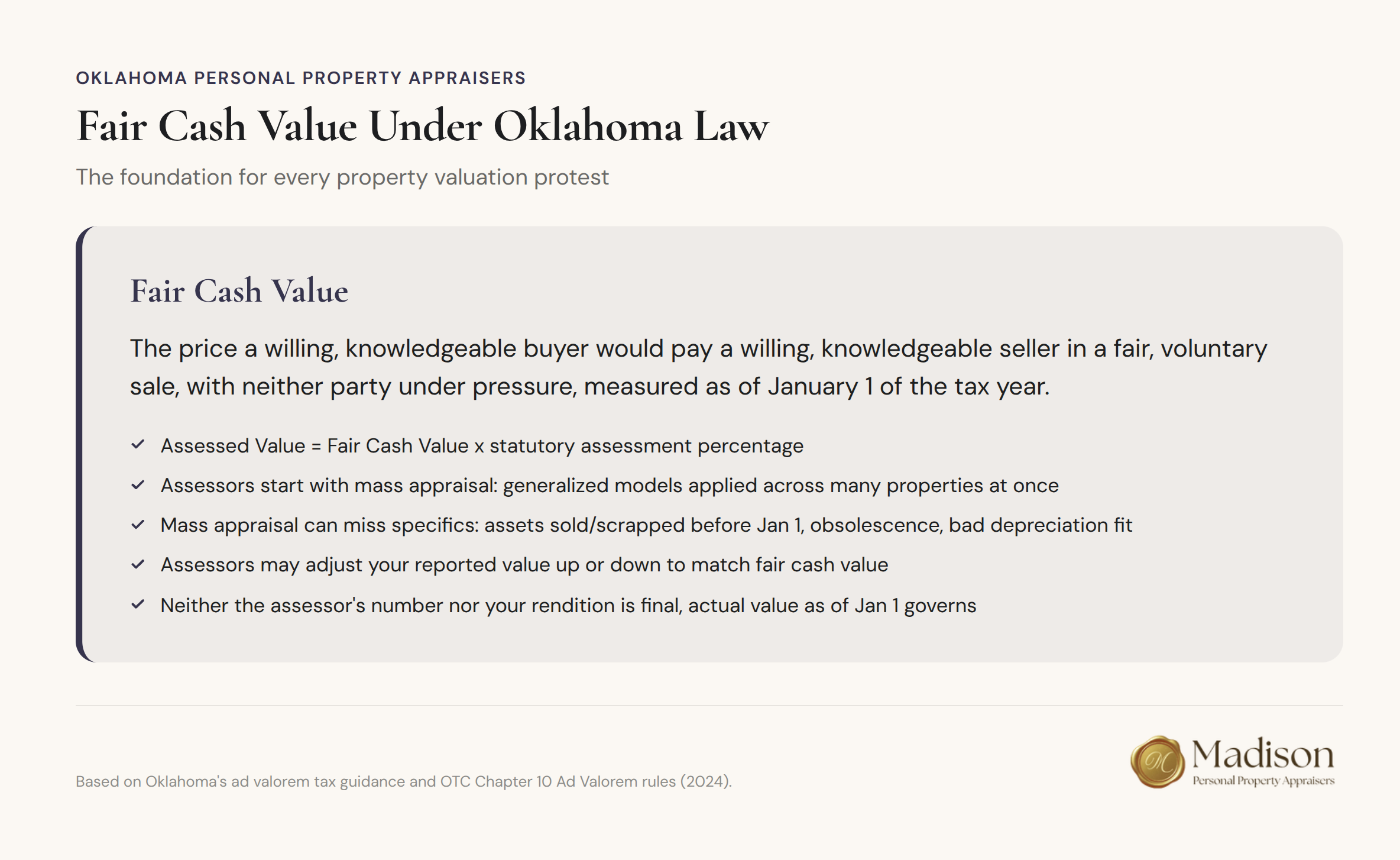
Oklahoma's ad valorem statutes define fair cash value as the price a willing, knowledgeable buyer would pay a willing, knowledgeable seller in a fair, voluntary sale, with neither party under pressure to act, measured as of January 1 of the tax year. Assessed value is a different number: it is fair cash value multiplied by the statutory assessment percentage, not the fair cash value figure itself.
County assessors arrive at fair cash value using an accepted mass appraisal methodology, applying generalized valuation models across large numbers of properties at once, as Oklahoma's ad valorem tax guidance explains. That efficiency is exactly why individual assessments sometimes miss asset-specific facts: equipment that was sold or scrapped before January 1, functional obsolescence in older machinery, or a depreciation schedule that does not match how the asset is actually used. The Oklahoma Tax Commission's rules governing the ad valorem process confirm that assessors apply these mass appraisal standards statewide while still permitting the assessor to adjust a taxpayer's reported value up or down to conform it to fair cash value. In other words, neither the assessor's mass appraisal number nor your own rendition is automatically the final word; the actual fair cash value as of January 1 is.
Step 1: Read Your Notice and Calendar the Deadline
Once a Notice of Increase in Valuation arrives, you generally have 30 calendar days from the date the notice was mailed, not the date you opened it, to file a written informal protest. Mark that mailing date the day the notice arrives, and count backward from there when you plan your evidence gathering.
There is one exception worth knowing: if your property's value did not increase or decrease from the prior tax year, you can instead file a protest on or before the first Monday in April. Most business owners protesting an increase will be working against the 30-day window, though, so treat that as your default deadline.
Watch out: missing the 30-day window means the assessor's proposed value becomes final for that tax year, with no further administrative recourse. There is no informal extension process, so file early rather than waiting until day 29.
Step 2: File Form 974 with the Oklahoma County Assessor
The informal protest itself is filed on the Oklahoma Tax Commission's current County Assessor Informal Protest form, Form 974. A generic letter disputing the value is not a substitute; the county expects the prescribed form, filled out completely.
A complete Form 974 filing should identify:
- Your business name, contact information, and the account or assessment identification number shown on the notice
- The property and tax year at issue
- The value the assessor assigned and the value you believe is correct
- The specific grounds for the objection, stated in plain, concise language
- The evidence supporting your requested value, such as an independent appraisal
- Your signature and the date
The form should state the relevant facts and specific objections clearly enough that someone unfamiliar with your business could understand exactly what you are disputing and why. "The value is too high" is not a protest; "the assessor's schedule includes three CNC machines that were sold and removed from the facility in March of last year" is.
Step 3: Strengthen Your Protest with an Independent Fair Cash Value Appraisal
An independent appraisal functions as rebuttal evidence, not an automatic override of the assessor's number. The county assessor, and later the Board of Equalization if you escalate, still weighs it alongside everything else in the file. That said, the strongest protests we see pair a specific, factual critique of the mass appraisal figure (wrong asset identification, missed depreciation, double-counted or disposed equipment, an inappropriate comparable) with an independently supported fair cash value as of January 1.
A useful appraisal for this purpose does a few things well:
- Identifies each asset precisely, including age, model, condition, and location
- States the January 1 valuation date explicitly, matching the statutory assessment date
- Explains the method used, whether cost approach, market approach with comparable sales, or income approach
- Clearly separates the fair cash value conclusion from the resulting assessed value, since assessors and Board members work in both figures
Pro tip: get the appraisal before the informal hearing, not after. You want the report in hand and attached to your Form 974 filing so the assessor's staff can review it before you ever sit down at the table.
Our team prepares USPAP-compliant personal property valuations that business owners use as this kind of supporting evidence in a Form 974 protest. We do not control what the assessor or Board decides, but a well-documented, asset-by-asset appraisal gives your protest something a mass appraisal model cannot: a specific, defensible number tied to your actual equipment and its actual condition.
Step 4: Attend the Informal Hearing
Once Form 974 is filed, the assessor's office must schedule an informal hearing to review the disputed value. At your request, this hearing can be held in person or by telephone, which matters if you are managing a business and cannot easily clear a block of time for an in-person meeting.
Bring your appraisal, your asset records, and a short written summary of your specific objections to the hearing. Walk through the discrepancies point by point rather than arguing the total number in the abstract. The assessor must issue a final decision within 7 calendar days after the informal hearing concludes.
Step 5: Escalate to the County Board of Equalization if Necessary
If you still disagree with the assessor's decision after the informal hearing, you can appeal to the County Board of Equalization. That appeal must be filed within 15 calendar days after the assessor's decision notice is mailed or delivered to you.
The entire process, from the original notice through a Board of Equalization decision, has to wrap up by May 31 or the Board's adjournment date, whichever applies. That is a hard outer boundary, so if your informal hearing happens late in the cycle, do not assume you have unlimited time to prepare a Board appeal.
Neighboring jurisdictions run a comparable process. Canadian County, for example, follows the same Form 974 informal protest framework, so if your business operates across county lines, expect a similar deadline structure on each notice you receive.
Key Deadlines at a Glance
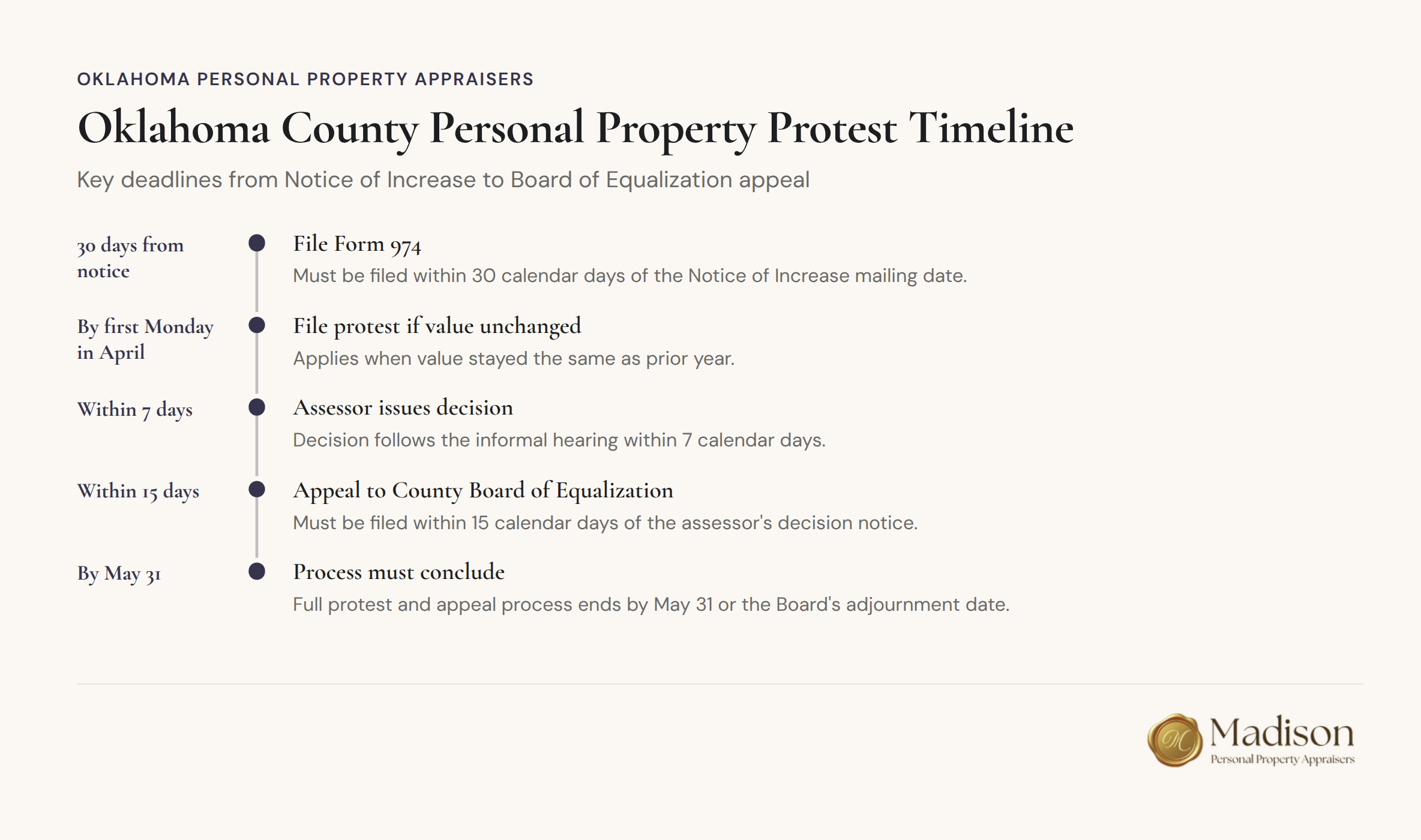
The table below summarizes the deadlines that govern an Oklahoma County personal property protest from notice to Board appeal.
| Stage | Deadline |
|---|---|
| File Form 974 after a Notice of Increase | 30 calendar days from the notice's mailing date |
| File a protest if value was unchanged from prior year | On or before the first Monday in April |
| Assessor's decision after the informal hearing | Within 7 calendar days of the hearing |
| Appeal to the County Board of Equalization | Within 15 calendar days of the assessor's decision notice |
| Full process must conclude | By May 31 or the Board's adjournment date |
Building a Protest That Holds Up
A personal property valuation protest succeeds or fails on specificity. General complaints about the tax bill go nowhere; a factual, asset-level challenge tied to fair cash value as of January 1 gives the assessor and the Board something concrete to act on. Filing Form 974 on time gets you in the door. An independent appraisal, built around your actual equipment rather than a generalized mass appraisal model, is often what turns that filing into a reduced assessment.
If you are preparing to protest a business personal property valuation in Oklahoma County, our appraisers can prepare a USPAP-compliant fair cash value appraisal built specifically for this kind of filing. Request an appraisal to get started before your 30-day window closes.
This article is provided for general informational purposes only and does not constitute legal, tax, or financial advice. Readers should consult a qualified attorney or CPA regarding their specific circumstances.