
Blog
Personal Property Appraisal for an Oklahoma Tornado or Hail Insurance Claim
When a tornado or hailstorm damages your household contents or business equipment, a personal property appraisal establishes what existed, its pre-loss condition, and its itemized replacement value so your Oklahoma insurance claim holds up under review.
Severe weather is a routine part of life in the Oklahoma City metro, and it does more than damage roofs and siding. Tornadoes, hail, and straight-line winds destroy furniture, electronics, tools, inventory, and the everyday contents that make a house or business function. This guide covers how personal property, meaning household goods and business contents, gets valued and documented for an Oklahoma insurance claim after storm damage, separate from any claim involving the structure itself.
What Counts as Personal Property in an Oklahoma Storm Claim?
Personal property, in insurance terms, means the movable contents of a home or business: furniture, appliances, electronics, clothing, tools, equipment, and inventory. It does not include the dwelling, a detached garage, or other real property, which fall under a separate coverage section (usually Coverage A or B) and require a real estate appraisal, not a personal property appraisal. If you're unsure whether a specific item qualifies as personal property for claim purposes, that distinction matters because it determines which coverage limit and which appraisal process applies.
Our team appraises the contents, never the structure. A personal property appraisal documents what you owned, its condition before the loss, and what it would cost to replace it, which is exactly the information an adjuster or an appraisal panel needs to resolve a contents dispute.
Oklahoma's Tornado and Hail Risk, by the Numbers
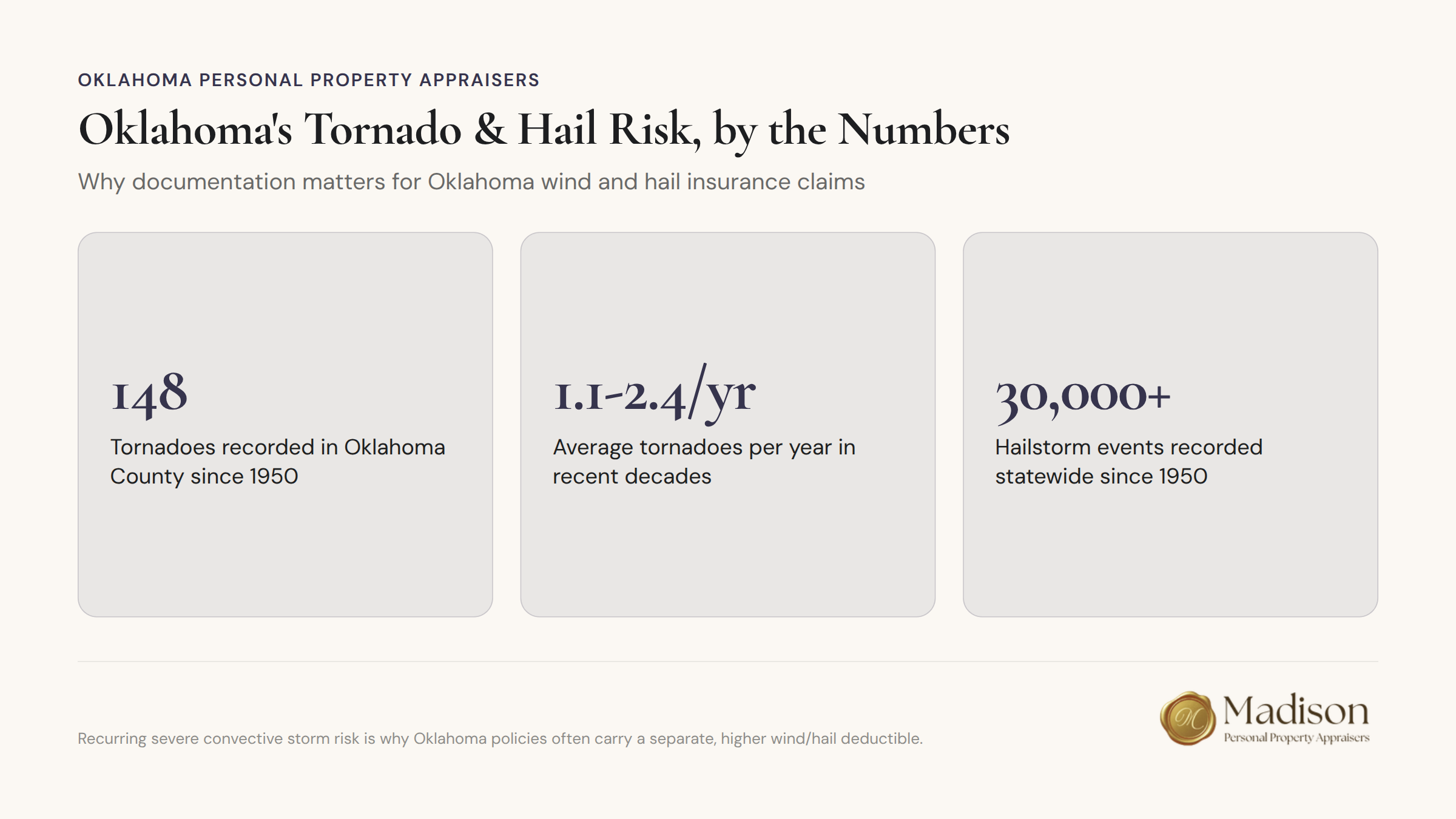
Oklahoma County has recorded roughly 148 tornadoes since 1950, averaging somewhere between 1.1 and 2.4 tornadoes per year in recent decades. Hail is an even more frequent hazard statewide, with more than 30,000 recorded hailstorm events across Oklahoma since 1950. That frequency is exactly why Oklahoma homeowners policies routinely carry a separate, higher deductible just for wind and hail losses, a detail that catches many policyholders off guard when they file their first claim.
This isn't a once-in-a-generation risk. It's a recurring one, which is also why documentation habits matter more here than in states where severe convective storms are rare.
Actual Cash Value vs Replacement Cost Value: What Your Policy Actually Pays
Most Oklahoma homeowners and business policies pay a claim on one of two bases, and the difference can mean thousands of dollars on a large contents loss. Actual cash value (ACV) is the replacement cost of an item minus depreciation for its age, wear, and condition. Replacement cost value (RCV) is what it would cost today to buy a new item of similar kind and quality, with no deduction for depreciation.
The Oklahoma Insurance Department's guidance on tornado and severe storm claims defines actual cash value as the amount it would take to repair or replace damaged property after depreciation, which is standard terminology across the insurance industry, not something specific to any one carrier. Many Oklahoma policies pay ACV up front and release the depreciation holdback once you actually replace the item and submit the receipt. That's a meaningful reason to keep an itemized appraisal report on hand: it gives you a documented pre-loss value to measure the replacement cost against, rather than relying on the adjuster's estimate alone.
Example: A five-year-old sectional sofa with an original cost of $2,400 might have a replacement cost of $2,800 today, but an ACV payout of $1,400 after depreciation. If the policy is written on a replacement-cost basis, the remaining $1,400 is paid once the new sofa is purchased and the receipt is submitted.
How Oklahoma's Appraisal Clause Works When You and Your Insurer Disagree
When you and your insurer can't agree on the dollar amount of a personal property loss, most Oklahoma homeowners and business policies include an appraisal clause that lets either party demand a formal appraisal. Each side selects its own appraiser, the two appraisers select a neutral umpire, and the umpire resolves any remaining disagreement on the amount of loss. This process settles the value of the loss; it does not decide whether the claim is covered in the first place.
One detail trips people up: whether an appraisal award binds the insurer depends entirely on the specific policy's wording. Some Oklahoma endorsements state that only the party who demanded the appraisal is bound by the result, according to industry legal commentary on Oklahoma appraisal endorsements. Read your policy's appraisal clause before you invoke it, and know how long the process typically takes before you plan around it; see our answer on how long an insurance appraisal takes for a realistic timeline.
What a USPAP-Compliant Personal Property Appraisal Documents
A personal property insurance appraisal exists to answer three questions an adjuster or umpire will ask: what did you own, what condition was it in, and what would it cost to replace. Reports prepared in accordance with USPAP (the Uniform Standards of Professional Appraisal Practice, published by The Appraisal Foundation) follow the development and reporting standards that apply specifically to personal property, covering identification, condition, and value conclusions in a defensible, standardized format.
A thorough report typically includes:
- Proof the property existed, through photographs, an itemized inventory, receipts, or serial numbers gathered before or immediately after the loss
- Pre-loss condition, noting wear, prior damage, age, and quality so the depreciation applied to an ACV claim is accurate rather than assumed
- Itemized replacement value, researched in the appropriate marketplace for each category of item, not a single lump-sum estimate
- A clear statement of intended use, so the report is built for an insurance claim rather than repurposed from a different assignment
Credentialed appraisers working in this field typically hold designations through organizations such as the ISA, AAA, or ASA, all of which train members to prepare reports adjusters and umpires can rely on without needing to second-guess the methodology.
Key takeaway: the burden of proof after a loss falls on the policyholder, not the insurer. A documented appraisal shifts that burden from your memory to a written record.
Wind and Hail Deductibles: Why They Matter for Your Payout
Many Oklahoma policies apply a separate, percentage-based deductible specifically for wind and hail losses, often around 1% of the coverage amount rather than a flat dollar figure. The Oklahoma Insurance Department's severe storm FAQs confirm that many carriers now build in an optional deductible that applies only to wind or hail events. Windstorm coverage for tornado and hail losses is standard across most homeowners and business policies nationally, though it's typically written separately from flood or earthquake coverage, which require their own endorsements.
That separate deductible applies to the whole storm loss, contents included, so an appraised value that's thorough and itemized matters more once a percentage-based deductible is subtracted from the total. Oklahoma law also ties certain premium discounts to wind-resistant retrofits, reflecting how seriously the state treats this category of risk; see 36 O.S. § 962 for the statutory framework behind those discounts.
Before the Storm: Documentation That Protects Your Claim
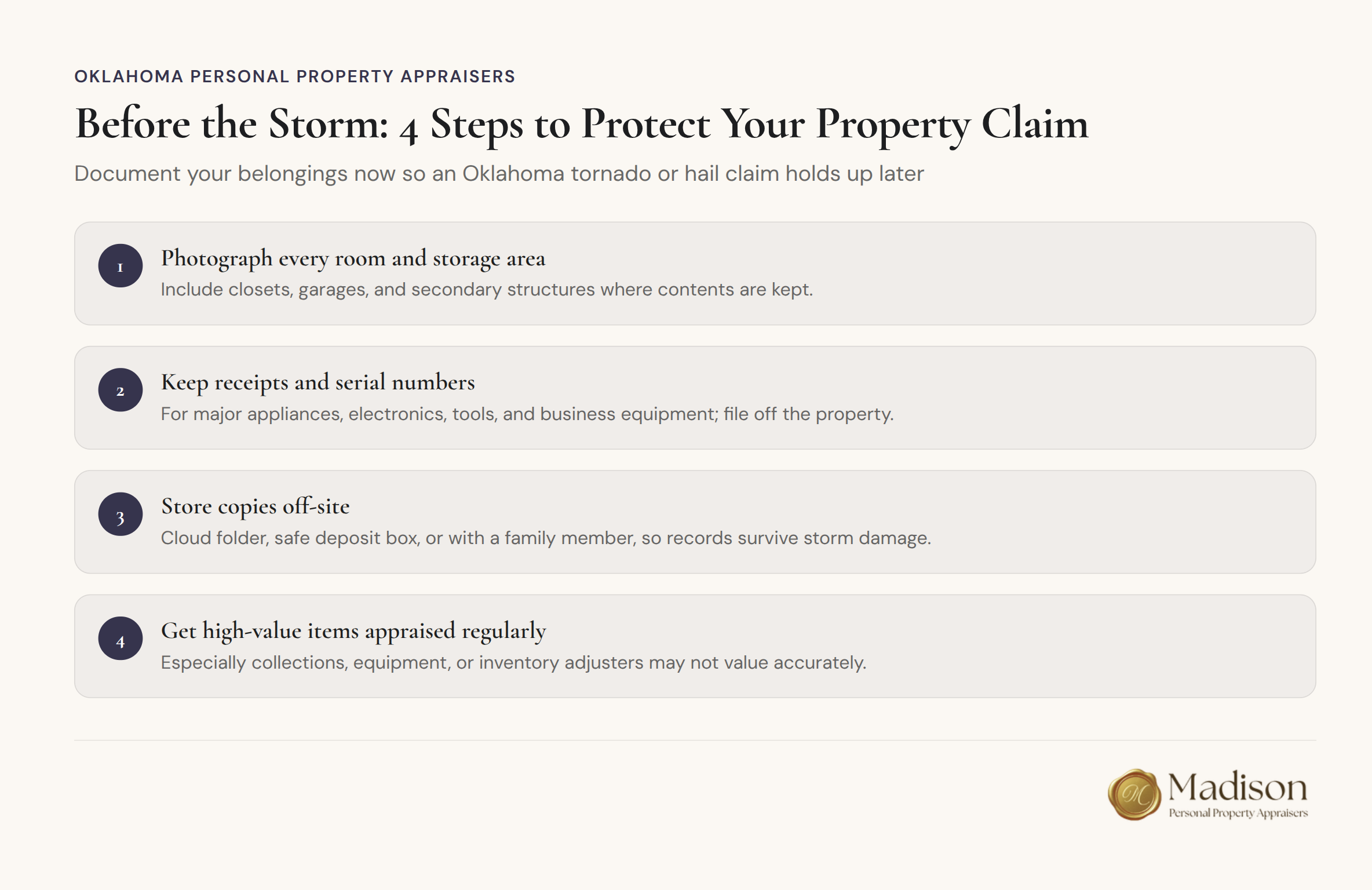
The strongest personal property claims start before the damage happens. Waiting until after a tornado or hailstorm to reconstruct what you owned is far harder, and far less credible to an adjuster, than having the record ready in advance.
- Photograph every room and storage area, including closets, garages, and any secondary structures where contents are kept.
- Keep receipts and serial numbers for major appliances, electronics, tools, and business equipment, filed somewhere other than the property itself.
- Store copies off-site, in a cloud folder, a safe deposit box, or with a family member, so the record survives even if the property doesn't.
- Get high-value items appraised on a regular basis, particularly collections, equipment, or inventory that an adjuster may not be equipped to value accurately on their own.
After the Damage: What to Do in the First Days
Once a tornado, hailstorm, or straight-line wind event damages your contents, act quickly but methodically. Notify your insurer promptly, photograph the damage before anything is discarded or repaired, and separate salvageable items from a total loss so both categories are documented clearly.
Business owners carrying commercial contents or inventory coverage face the same pressure on a larger scale: a warehouse or retail loss can involve hundreds of line items that need to be counted, described, and valued individually rather than estimated as a lump sum. In either case, an independent, itemized appraisal gives you a documented position to bring into the adjuster conversation or into a formal appraisal demand if the two sides can't agree.
What a Personal Property Appraisal Costs
Our household contents appraisals for insurance purposes start at $195 for standard reporting and $295 when the report needs to meet a more advanced, IRS-qualified standard of documentation; most household storm claims fall between $395 and $2,200 depending on the number of items and the depth of research required. Business contents and inventory appraisals start at $495, typically running $695 to $3,500 for a full facility or warehouse loss. Every engagement is quoted as a fixed fee after we understand the scope, the number of items, and the intended use of the report; we never bill by the hour. For a fuller breakdown of what drives that scope, see our page on what it costs to get property appraised.
Protect Your Claim with a Documented Appraisal
Oklahoma's tornado and hail history isn't going anywhere, and neither is the burden that falls on policyholders to prove what they owned and what it was worth. A documented, itemized personal property appraisal turns that burden into a straightforward record, one an adjuster, umpire, or insurer can review without a fight over the details.
This article is provided for general informational purposes only and does not constitute legal, tax, or financial advice. Readers should consult a qualified attorney or their insurance carrier regarding their specific circumstances.
If your household or business contents were damaged in a recent Oklahoma storm, our appraisers can prepare a personal property appraisal built for your insurance claim from the ground up.