
Blog
How Oklahoma Probate Courts Handle Personal Property Inventory and Appraisal
Oklahoma probate law lets an executor state their own opinion of value for personal property, until an heir or creditor demands a formal appraisal. Here is exactly when Title 58 requires court-appointed appraisers, and when it does not.
When someone dies owning personal property in Oklahoma, a personal representative (the executor or administrator) has to account for it to the probate court before anything can be distributed. Oklahoma does not always require a professional appraiser for that accounting, but the rules for when one is required, and when the executor can simply state a value, trip up a lot of first-time personal representatives. This guide walks through Title 58 of the Oklahoma Statutes, Chapter 5, and explains exactly what triggers a court-ordered appraisement versus what an executor can handle alone. If you are serving as a personal representative and need our Oklahoma personal property appraisers to prepare a defensible fair market value report, this is the framework you are working within.
What Counts as Probate Personal Property in Oklahoma?
Probate personal property is anything the decedent owned outright at death that is not real estate and does not pass automatically through a beneficiary designation or joint ownership. That includes furniture, vehicles, jewelry, tools, collections, business equipment, and household goods. It does not include assets held in a revocable trust, property owned in joint tenancy with right of survivorship, or accounts with a valid transfer-on-death or payable-on-death designation, since those pass outside probate entirely.
Understanding what qualifies as personal property matters before you ever get to the appraisal question, because the inventory only needs to capture what is actually part of the probate estate. Homestead and other exempt personal property must still be specifically designated in the inventory even though it may not be subject to creditor claims.
The Two-Month Inventory Deadline Under Title 58, Section 281
Once a personal representative is appointed, Oklahoma law requires an inventory of the estate's property to be filed with the probate court within two months, unless the court grants an extension for good cause. The personal representative's obligation under Title 58, Section 281 applies to real and personal property alike, and it does not wait for creditor claims or other probate steps to wrap up first.
Here is the part that surprises most new executors: the statute does not automatically require an outside appraiser. Section 281 states that the personal representative "may fulfill the appraisement requirement by stating his opinion of the value" of the property listed in the inventory. In plain terms, for a typical estate with ordinary household goods, a car, and some furniture, the executor can list each item and assign a value themselves, sign the inventory, and file it. No appraiser is required unless something else in the statute triggers one.
When the Executor's Own Opinion of Value Is Enough
An executor's own stated opinion of value satisfies Oklahoma's appraisement requirement in most routine estates, as long as no interested party formally objects. This keeps the process fast and inexpensive for families with modest, straightforward personal property.
That said, "enough to satisfy the statute" and "enough to avoid a dispute" are two different standards. An executor's opinion carries no independent credibility if a sibling later argues the antique clock was worth $8,000, not the $800 the executor wrote down. The statute gives you the option to self-report values; it does not protect you from the consequences of getting those values wrong.
When Oklahoma Courts Order a Formal Appraisement
A court must order a formal appraisement whenever an heir, devisee, legatee, creditor with a filed claim, guardian, or other interested person makes a written demand for one. Once ordered, the appraisement is handled by three disinterested, court-appointed appraisers, any two of whom may act, under Title 58's rules governing collection and inventory of the estate.
These court-appointed appraisers take an oath to "truly, honestly and impartially appraise the property exhibited to them, according to the best of their knowledge and ability," and they are entitled to reasonable compensation, statutorily set at up to $75 per day unless the court orders otherwise. They must list each article of personal property separately with its value in dollars and cents, and they file a verified account of their services along with the inventory.
The practical trigger is almost always a dispute. A disgruntled heir who suspects undervaluation, a creditor trying to confirm there are enough assets to satisfy a claim, or a guardian representing a minor beneficiary can all force a formal appraisement simply by filing a written demand with the court.
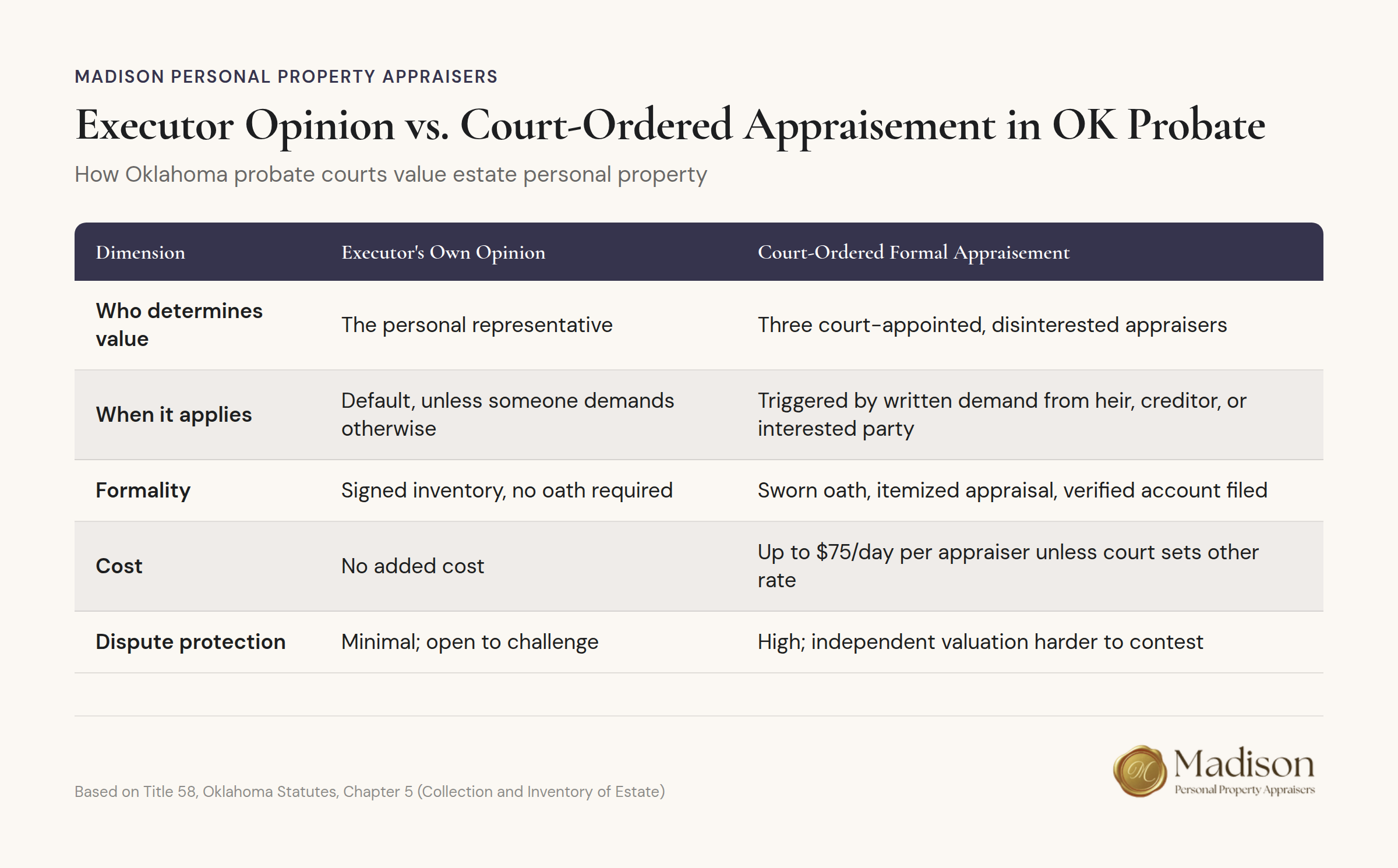
| Executor's Own Opinion of Value | Court-Ordered Formal Appraisement | |
|---|---|---|
| Who determines value | The personal representative | Three court-appointed, disinterested appraisers |
| When it applies | Default, unless someone demands otherwise | Triggered by a written demand from an heir, creditor, or other interested party |
| Formality | Signed inventory, no oath required | Sworn oath, itemized appraisal, verified account filed with the court |
| Cost | No added cost | Statutory appraiser compensation, up to $75/day per appraiser unless the court sets a different rate |
| Dispute protection | Minimal; open to challenge | High; independent valuation is harder to contest |
Estates Under $60,000: The Threshold That Triggers Automatic Appraisers
When the combined real and personal property in an estate does not exceed $60,000, Oklahoma law shifts the default. Under this smaller-estate rule, the court must order an inventory and generally must appoint appraisers once a personal representative is appointed, unless the court specifically determines that an appraisement is not necessary.
This is the reverse of the general rule. In a larger estate, the executor's opinion is the default and a formal appraisal is the exception. In a smaller estate, a formal appraisal is closer to the default, and the court has to affirmatively decide it is not needed to skip it. If you are administering a smaller estate, do not assume the low dollar value means less paperwork. It can mean more oversight, not less.
All-Cash Estates Skip the Appraisement Requirement
If the entire estate consists of money and nothing else, no appraisement is required at all, even though a formal inventory still is. This is a narrow exception. The moment a decedent's estate includes a vehicle, a piece of furniture, jewelry, or any other tangible item, the exception no longer applies, and the standard inventory and appraisement rules described above kick back in.
The Small Estate Affidavit: Bypassing Probate Entirely
Oklahoma also allows some estates to skip formal probate altogether. When an estate's personal property falls under the state's small estate affidavit threshold, an heir or successor can use a simplified affidavit process to collect and transfer the decedent's personal property without opening a full probate case. This route generally applies only to smaller estates and works best when there is no real estate dispute, no contested will, and no significant creditor activity.
Even when a family qualifies for the small estate affidavit, having a documented, defensible value for the personal property being transferred is worth doing anyway. Banks, title companies, and other institutions receiving the affidavit often want to see how the values were determined, and a professional valuation avoids awkward follow-up questions later.
Why a Professional Fair Market Value Appraisal Still Makes Sense
Even when Title 58 does not require a formal appraisement, a professional fair market value appraisal is often the cheapest insurance a personal representative can buy against a later dispute. Oklahoma has no state estate or inheritance tax, so the appraisal is not serving a state tax purpose here. Instead, it protects the executor and the estate in three specific ways: equitable distribution among heirs, informed decisions about whether to sell an asset or distribute it in kind, and a defensible record if a creditor challenges the estate's solvency.
An independent appraiser working to fair market value standards has no stake in the outcome, unlike an executor who may also be an heir. That independence is exactly what a formal appraisement is designed to provide, and a private engagement gets you the same protection without waiting for a demand to force the issue.
Pro tip: If even one heir has expressed frustration about how the estate is being handled, get a professional appraisal before that frustration turns into a written demand for a court-ordered appraisement. It is far cheaper to be proactive than to respond to a formal challenge.
Our personal property appraisal engagements for Oklahoma estates are quoted as a fixed fee after we scope the assignment, based on the number of items, their complexity, and whether the report needs to meet IRS-qualified standards. For estate personal property, our standard reports start at $195, with typical engagements running $395 to $2,200 depending on the size and complexity of the estate. You can review what it costs to get property appraised for more detail on how scope drives the fee. Appraisers who handle this kind of estate work typically hold credentials with organizations such as the ISA, ASA, AAA, or CAGA, and prepare reports in accordance with USPAP so the values hold up under scrutiny from heirs, creditors, or the court.
Filing and Verifying the Inventory
Whoever prepares the inventory, whether the executor alone or court-appointed appraisers, the document filed with the court must be signed and verified. The person who valued the property must attest that they did so impartially and to the best of their knowledge and ability, and that attestation is what gives the inventory legal weight in the probate file.
Oklahoma State University Extension materials describe this filing step as happening while notice to creditors is running, which means most personal representatives are juggling the inventory deadline alongside other early probate tasks. Missing the two-month window does not usually derail an estate, but it invites the court to ask questions, and an extension has to be requested for good cause rather than assumed.
As a practical checklist, the inventory generally needs to cover real property, bank and investment accounts, personal possessions, and business interests, which helps a first-time personal representative make sure nothing important gets left off.
Getting It Right the First Time
Most Oklahoma estates never see a court-ordered formal appraisement. The executor's own opinion of value, filed on time and signed under the required attestation, satisfies the statute for the vast majority of estates. But "satisfies the statute" is a low bar compared to "stands up if a sibling disagrees" or "survives a creditor's challenge to the estate's solvency." A professional fair market value appraisal costs a fraction of what a contested probate case does, and it gives every heir and every creditor the same independent number to work from.
If you are serving as a personal representative in Oklahoma and want a USPAP-compliant, defensible valuation of the estate's personal property, request an appraisal and we will scope the assignment based on what the estate actually contains. For more on how personal property valuations work across estate, tax, insurance, and donation situations, browse our guides to Oklahoma personal property appraisal.
This article is provided for general informational purposes only and does not constitute legal, tax, or financial advice. Readers should consult a qualified attorney or CPA regarding their specific circumstances.