
Blog
Oklahoma's 10% Household Personal Property Rule: How to Challenge it with a Fair Cash Value Appraisal
Oklahoma's 10% household personal property rule assumes your furnishings are worth a tenth of your home's structure value, whether or not that's true. This guide explains the statute, the appeal deadlines, and how a fair cash value appraisal can lower an inflated assessment.
What Is the 10% Household Personal Property Rule in Oklahoma?
Oklahoma law does not require county assessors to walk through your house and count your furniture. Instead, 68 O.S. Section 2817 sets a default: the fair cash value of household personal property is presumed to be 10% of the appraised value of the improvement on residential real property, assessed as of January 1 each year. "Improvement" here means the structure itself, not the land it sits on.
That 10% figure is a legal shortcut, not a physical inventory. It exists because assessors handle tens of thousands of parcels and cannot reasonably inspect the contents of every home every year. The same statute makes clear this figure is a rebuttable presumption: a taxpayer may alter the assessment by listing the household personal property at its actual fair cash value. In other words, the law assumes 10% unless you prove otherwise.
This matters because household personal property assessments feed directly into your annual ad valorem tax bill, alongside the assessed value of the real estate itself. If you understand what qualifies as personal property in your home and how it's valued, you're in a much stronger position to know whether the 10% default is fair to you.
Why the 10% Formula Often Overstates What Homeowners Actually Own
The 10% rule assumes a rough correlation between a home's structural value and the value of what's inside it. For plenty of households that correlation holds up reasonably well. For plenty of others, it doesn't come close.
Think about who ends up on the wrong side of this formula:
- Downsizers and empty nesters who live in a larger, higher-value home but have already sold, donated, or passed down most of their higher-value furnishings to adult children.
- Older homeowners with furniture, appliances, and decor purchased decades ago, now heavily depreciated in real market terms even though the home's structural value has appreciated.
- Minimalist households who simply own less than an assessor's formula assumes, regardless of home size.
- Owners of newly built or recently renovated homes where the improvement value jumped due to construction costs, while the furnishings moved over from a previous, smaller residence unchanged.
In each of these cases, the home's structure carries a value that has nothing to do with the actual condition or quantity of the furniture, electronics, and household goods inside it. Oklahoma's tax rules assess tangible personal property at 10% to 15% of its fair cash value under the state constitution, and real property separately at 11% to 13.5% of fair cash value, according to Oklahoma's Chapter 10 ad valorem rules. When the underlying fair cash value estimate for household goods is inflated by the 10% formula, that inflated number carries through the entire calculation.
Watch out: The 10% rule applies to household personal property tied to a residence. It does not apply the same way to business personal property, which Oklahoma requires owners to render and list separately each year.
Worked Example: Comparing the 10% Default to an Itemized Fair Cash Value
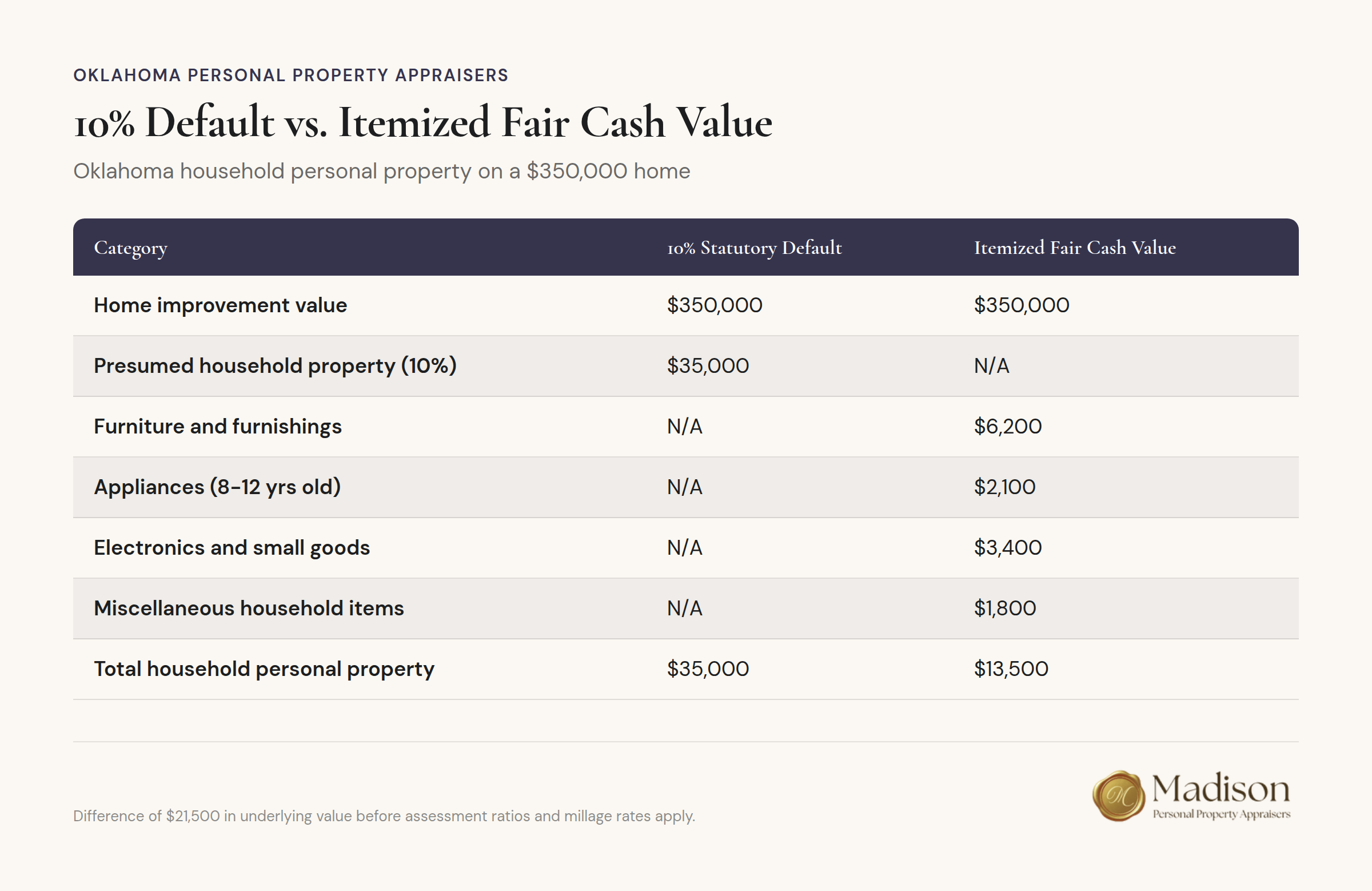
A direct answer first: if your home's improvement value is $350,000, the statutory default assumes $35,000 of household personal property, whether or not that number reflects reality.
Here's how that plays out for a hypothetical Oklahoma City area homeowner who downsized five years ago and furnished a smaller retirement home mostly with items brought from a prior residence.
| Category | 10% Statutory Default | Itemized Fair Cash Value |
|---|---|---|
| Home improvement value | $350,000 | $350,000 |
| Presumed household personal property (10%) | $35,000 | N/A |
| Furniture and furnishings (actual, depreciated) | N/A | $6,200 |
| Appliances (actual, 8-12 years old) | N/A | $2,100 |
| Electronics and small goods | N/A | $3,400 |
| Miscellaneous household items | N/A | $1,800 |
| Total household personal property value | $35,000 | $13,500 |
Example: Under the default rule, this homeowner's household goods are assessed as if worth $35,000. An itemized, dated fair cash value listing supported by condition notes and market research documents a real total closer to $13,500, a difference of $21,500 in the underlying value before assessment ratios and millage rates are even applied.
That gap doesn't disappear on its own. It only changes if the homeowner files a listing and, when challenged, backs it up with credible evidence.
How to Challenge the Presumption: the Appeal Process Step by Step
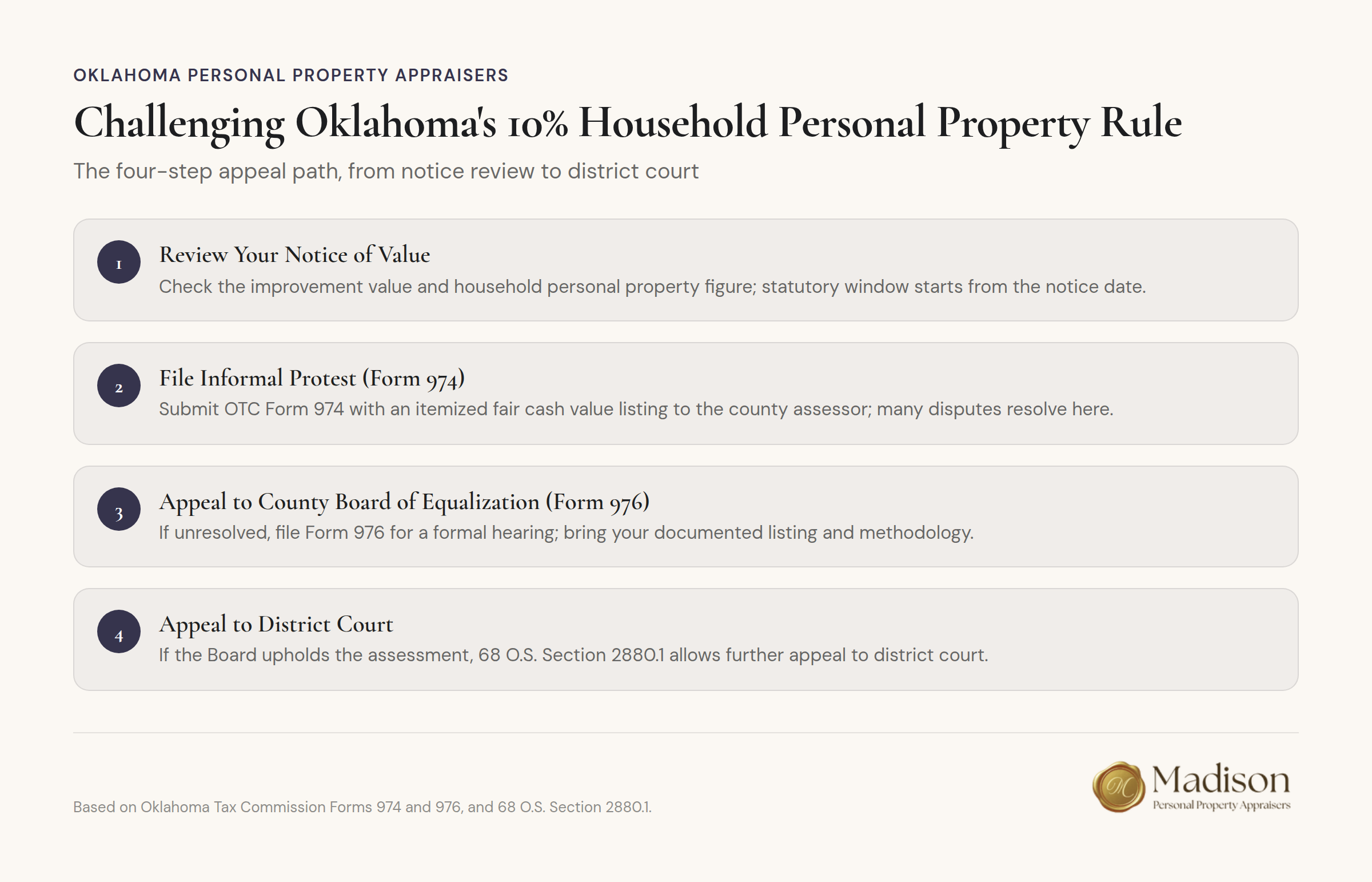
Oklahoma gives taxpayers two chances to correct an inflated household personal property assessment before heading to court, starting with an informal conversation with the county assessor.
- Review Your Notice of Value
- Each county assessor mails a notice of value, and the statutory window to act starts running from that notice date. Confirm the improvement value used and the household personal property figure derived from it.
- File an Informal Protest with the County Assessor
- Oklahoma Tax Commission Form 974 is used to informally protest the assessed value within the statutory window after the notice of value is mailed. Submit your itemized fair cash value listing at this stage, since many disputes resolve here without a hearing.
- Appeal to the County Board of Equalization
- If the assessor doesn't adjust the value to your satisfaction, Oklahoma Tax Commission Form 976 moves the dispute to the County Board of Equalization for a formal hearing. Bring your documented listing and be ready to explain the methodology behind it.
- Appeal to District Court if Necessary
- If the Board of Equalization upholds the original assessment, 68 O.S. Section 2880.1 provides for further appeal to district court.
Pro tip: File your informal protest as early as possible in the statutory window. Assessors are far more receptive to a documented listing before a hearing is scheduled than after.
What a Defensible Fair Cash Value Listing Actually Looks Like
The statute doesn't require a professional appraisal to override the 10% presumption. It requires a listing of the property at its actual fair cash value. In practice, that distinction matters less than it sounds, because assessors and boards default back to the 10% figure whenever a taxpayer's listing lacks credible support.
A listing that actually moves the needle typically includes:
- An itemized inventory of household personal property, organized by category, with descriptions specific enough to identify each item or grouping.
- Condition and age notes for major items, since depreciation is a core driver of the gap between original cost and current fair cash value.
- Market-based value conclusions, not replacement cost figures, since fair cash value in Oklahoma is defined by what a willing buyer and willing seller would agree to, not what it would cost to buy new.
- A dated report tied to the January 1 assessment date the county is using.
This is exactly the kind of documentation a personal property appraisal is built to produce. Appraisers who follow the Uniform Standards of Professional Appraisal Practice (USPAP), and who hold credentials through organizations such as the International Society of Appraisers (ISA), the American Society of Appraisers (ASA), or the Appraisers Association of America (AAA), are trained specifically to reach a defensible fair cash value conclusion rather than a rough estimate. A report built this way gives a county board something concrete to weigh against the statutory default, instead of asking them to take a homeowner's word for it.
Key takeaway: The 10% rule is a presumption, not a fact about your home. It shifts the moment you present a credible, itemized fair cash value listing, and the strength of that listing is usually what decides the outcome.
Getting a Fair Cash Value Appraisal for Your Household Personal Property
Homeowners in the Oklahoma City area who suspect the 10% rule is overstating their household goods have a clear path forward: document the actual fair cash value and file it within the statutory windows described above. Our team prepares itemized, USPAP-compliant fair cash value reports for exactly this purpose, whether you're preparing for an informal protest or a formal hearing before the County Board of Equalization. If you're ready to see how your home's actual contents compare to the statutory default, you can request an appraisal and we'll scope the assignment to your property.
This article is provided for general informational purposes only and does not constitute legal, tax, or financial advice. Readers should consult a qualified attorney or CPA regarding their specific circumstances and confirm current forms and deadlines with their county assessor's office.