
Blog
How Oklahoma Divorce Courts Value and Split Household Goods and Collections
Oklahoma divorce courts divide marital personal property on a "just and reasonable" standard, not an automatic 50/50 split, and that standard starts with an accurate fair market value for every household item and collection. Here's how furniture, vehicles, firearms, and collections actually get valued and divided under Oklahoma law.
Divorce in Oklahoma City means dividing more than a house and a retirement account. Furniture, vehicles, firearms, and family collections all have to be sorted into separate or marital property and then valued before anyone can negotiate a fair split. This guide walks through how Oklahoma's equitable distribution law treats household goods and collections, and how a professional appraisal gives both spouses and their attorneys a number everyone can rely on.
Our appraisers prepare personal property appraisals for divorce matters across Oklahoma City, and the question we hear most often is some version of "who decides what this is worth?" The short answer: not either spouse. A qualified appraiser determines fair market value independently, and the court applies the law to divide it.
Oklahoma Is an Equitable Distribution State, Not Community Property
Oklahoma does not split marital property 50/50 by default. Under 43 O.S. § 121(B), the court must first confirm each spouse's separate property, meaning anything owned before the marriage or acquired afterward in that spouse's own right (an inheritance or a gift, for example). Everything else that was jointly acquired during the marriage becomes part of the marital estate.
Once the marital estate is identified, the statute directs the court to divide it in a way that is "just and reasonable." That phrase does real legal work. Oklahoma appellate decisions have repeatedly confirmed that "just and reasonable" is an equitable standard, not a mandate for an equal split, and trial courts hold broad discretion over how assets and debts land on each side of the ledger, as reflected in published decisions from the Oklahoma Court of Civil Appeals. A judge can award a collection entirely to one spouse and offset it with other property, cash, or a larger share of a different asset.
This matters enormously for household goods and collections, because the dollar value assigned to a coin collection or a truck determines how much other property the other spouse receives in exchange. An inflated or deflated number skews the entire settlement, not just that one line item.
How Oklahoma Courts Divide Household Goods and Collections
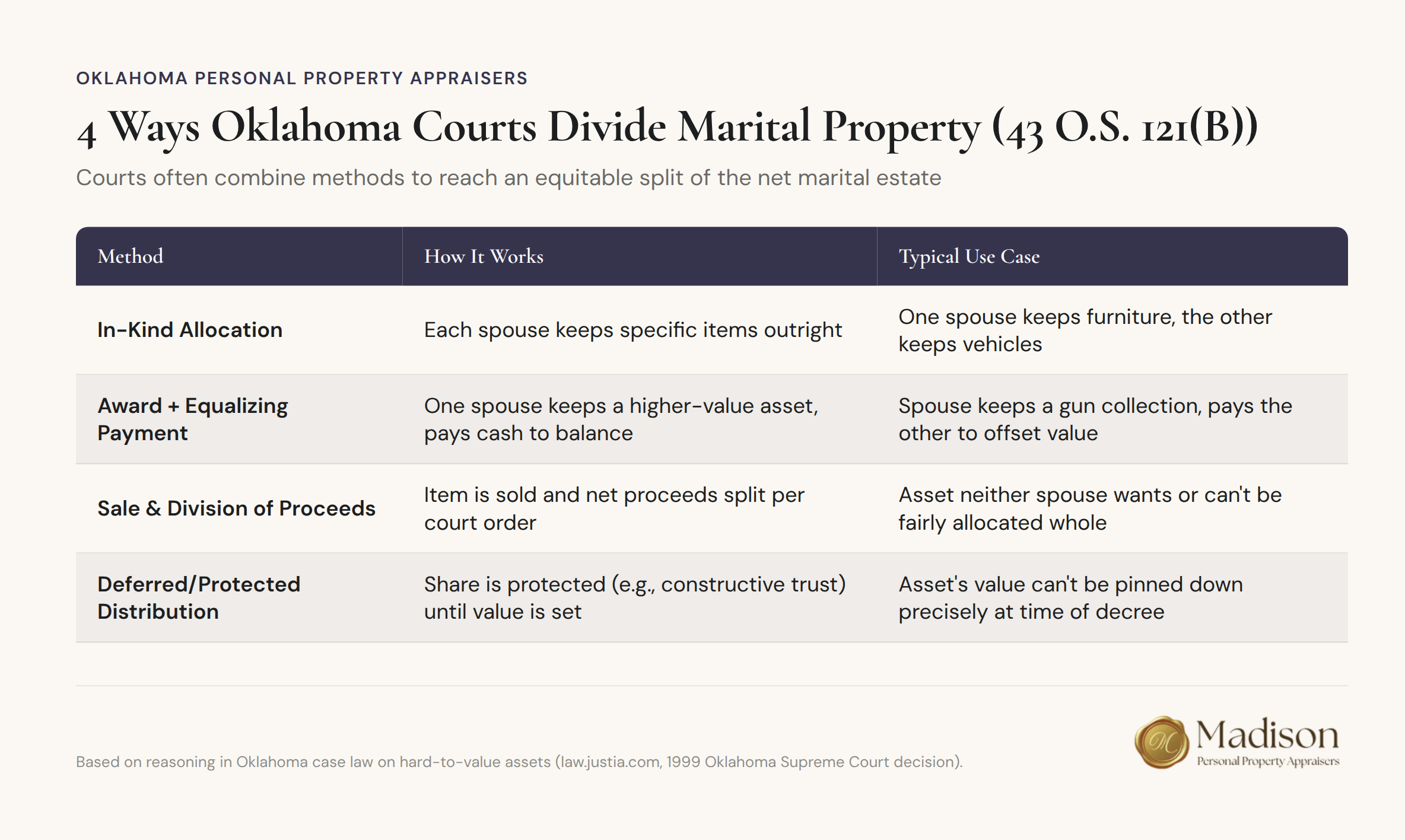
Courts generally have four tools available for dividing marital personal property under the statute, and a single divorce often uses more than one:
- In-kind allocation: Each spouse keeps specific items, such as one spouse keeping the furniture and the other keeping the vehicles.
- Award plus equalizing payment: One spouse keeps a higher-value asset, like a gun collection, and pays the other spouse a cash amount to balance the scales.
- Sale and division of proceeds: Items are sold and the net proceeds split according to the court's order.
- Deferred or protected distribution: Used when an asset's value cannot be pinned down precisely at the time of the decree. Oklahoma courts have recognized tools such as a constructive trust to protect the other spouse's eventual share in these situations, consistent with reasoning in cases addressing assets that are difficult to value at the time of decree.
The court is also weighing the net marital estate, not each category in isolation. A spouse who keeps a valuable coin collection may receive less cash, less furniture, or a smaller share of another asset to keep the overall division equitable. That is exactly why getting the appraised value right, on both sides of the equation, carries so much weight.
What Valuation Date Applies to Your Divorce?
Oklahoma's statute does not set one mandatory valuation date for every divorce. Courts have discretion, and in practice the date tied to filing or the date of trial are both common reference points depending on the facts of the case and the judge assigned.
This is not a detail to guess at. Values for vehicles, firearms, and collectible markets can shift meaningfully over the months a divorce is pending, so confirm the controlling valuation date with your attorney early, before an appraisal is scheduled. An appraisal dated to the wrong moment in time can undercut its usefulness in settlement talks or at trial.
How Appraisers Determine Fair Market Value for Household Goods
For ordinary household goods, the relevant question is fair market value, the price a willing buyer would pay a willing seller, with neither party under compulsion and both having reasonable knowledge of the facts. That is the same benchmark used in federal valuation regulations covering household and personal effects, and it is the standard our appraisers apply in Oklahoma divorce matters as well.
Federal valuation guidance recognizes three core approaches to arriving at that figure, and the right one depends on the asset:
- Market approach: Comparing the item against actual sales or current listings of comparable property. This is the primary approach for furniture, appliances, electronics, and most vehicles.
- Cost approach: Estimating replacement or reproduction cost and adjusting for age, condition, and obsolescence. Used less often for used household goods, since retail replacement cost rarely matches resale reality.
- Income approach: Capitalizing income the property generates or could generate. Rarely relevant to household contents, but occasionally applicable to income-producing collectibles or equipment.
For most household goods, the market approach is the most defensible choice, because used furniture and appliances typically carry values well below what they cost new. A credible inventory for divorce purposes identifies each item, its age and condition, comparable sales or listings, and a proposed value. Lumping an entire room into one bundled number holds up far worse under scrutiny than an itemized report, particularly when the spouses disagree about specific pieces.
Pro tip: If you and your spouse disagree about even a handful of specific items, request an itemized appraisal rather than a bundled estimate. Itemization is what lets an attorney negotiate item by item instead of all-or-nothing.
Why Collections Get Appraised as a Whole, Not Item by Item
Collections, whether coins, firearms, fine art, antiques, or sports memorabilia, require a different approach than a living room set. Federal valuation guidance specifically calls out jewelry, paintings, antiques, books, and coin or stamp collections as property that can carry value well beyond a casual estimate, and that same principle applies in divorce valuation.
A collection's value as a whole can be higher or lower than simply adding up what each piece might sell for individually. A complete set, a matched pair, or a few rare pieces within an otherwise ordinary collection can drive the total well above a piece-by-piece guess. Conversely, a collection that looks impressive but is missing key pieces, has condition problems, or includes reproductions can be worth considerably less than a spouse assumes. That is why our appraisers evaluate collections as a unit, documenting completeness, authenticity, condition, rarity, and recent comparable sales, rather than pricing each item in isolation.
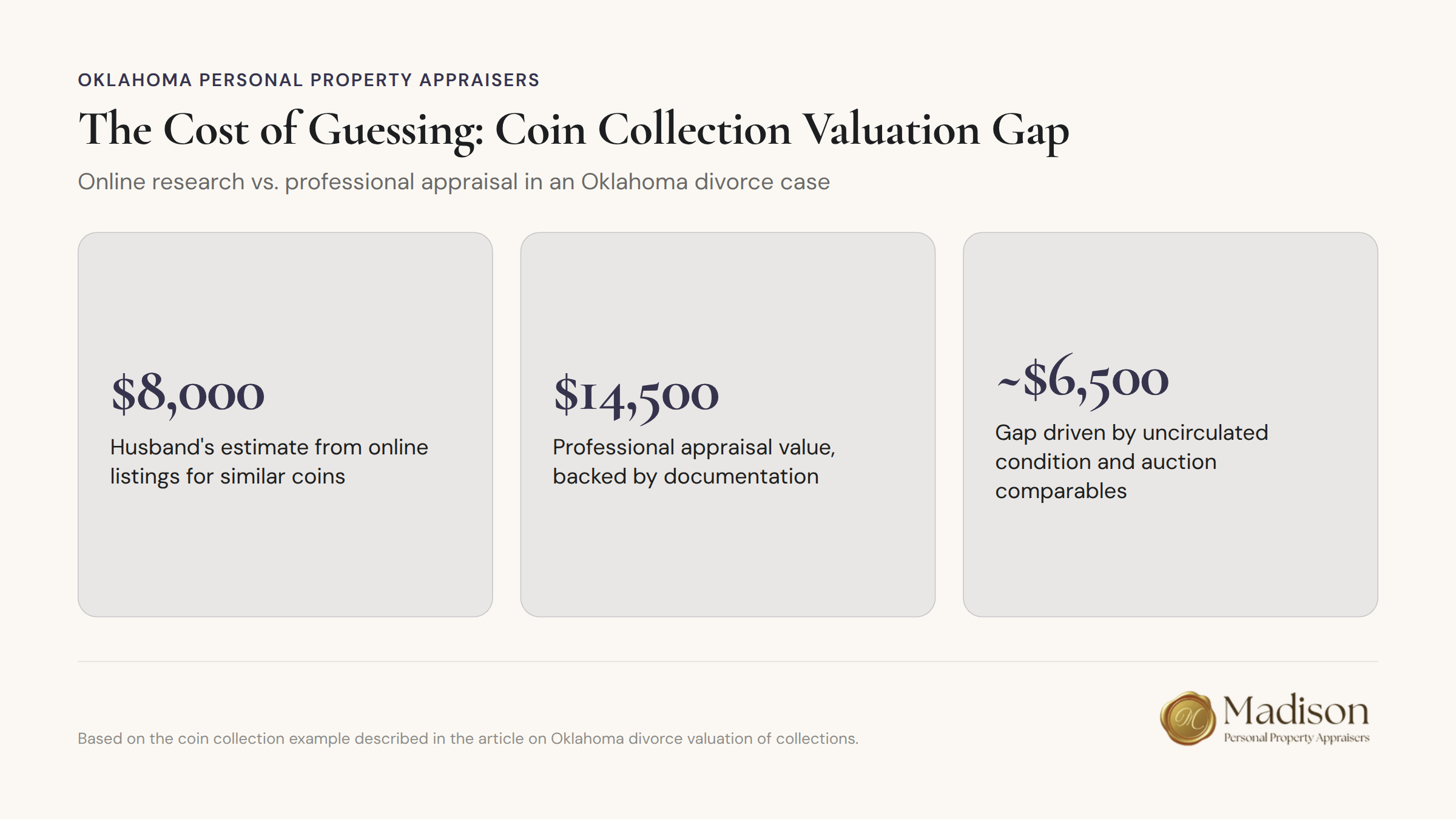
Example: A husband estimates the couple's coin collection is worth about $8,000, based on prices he found for similar coins listed online. A professional appraisal, accounting for two key pieces in uncirculated condition and documenting recent auction results for comparable lots, values the collection at $14,500. Because the valuation date and documentation held up, the wife's attorney used the appraised figure, not the online listing estimate, in settlement negotiations, and the husband kept the collection in exchange for a larger share of other marital assets.
The same logic applies to a firearms collection, where factors like manufacturer, model variations, and documented provenance can swing value significantly from what a general online search suggests. Our firearms appraisal work follows the same market-based, documented approach for divorce matters as it does for insurance or estate purposes.
The Appraiser's Role Is Neutral
An appraiser hired for a divorce does not work for either spouse's interests. The job is to determine fair market value as of the applicable date, independent of what either party wants the number to be, and to document the methodology clearly enough that both attorneys and the court can rely on it.
Our appraisers prepare reports in accordance with USPAP (the Uniform Standards of Professional Appraisal Practice), the same standards that apply across insurance, estate, and donation appraisals. That consistency matters in a courtroom setting: a report built to a recognized standard is far easier for an attorney to introduce and defend than an informal estimate or a spouse's own valuation.
Watch out: A spouse's own estimate, even a sincere one, is rarely persuasive evidence on its own. Courts and opposing counsel expect documented comparables, not a number pulled from memory or a quick online search.
What Does a Divorce Personal Property Appraisal Cost in Oklahoma City?
For a full-household personal property appraisal prepared for a divorce or equitable distribution matter, our fee is quoted as a fixed amount after we scope the assignment, generally starting at $4,500 for an online appraisal and $7,000 when an on-site visit is required. The fee reflects the number of items, the mix of ordinary household goods versus collections requiring deeper research, and whether the report needs to meet a specific court or attorney requirement, not the dollar value of what is being appraised or how likely a judge is to accept it.
Engagements are quoted and agreed before work begins. There is no hourly billing and no surprise invoice at the end. If you're unsure which option fits your situation, our frequently asked questions on personal property appraisal costs walks through how scope affects the fee across different appraisal types.
Getting the Valuation Right Before you Negotiate
A divorce settlement is only as fair as the numbers behind it. Oklahoma's "just and reasonable" standard gives courts flexibility, but that flexibility cuts both ways: without a credible, independent valuation, one spouse's guess about a collection or a houseful of furniture can quietly tilt the entire division. Getting an appraisal before negotiations start, not after a dispute erupts, gives your attorney a number to work with rather than an argument to have.
If you're heading into a divorce in Oklahoma City and need a household or collection valued for settlement purposes, our appraisers can scope the assignment and provide a fixed-fee quote before any work begins.
This article is provided for general informational purposes only and does not constitute legal, tax, or financial advice. Readers should consult a qualified attorney regarding their specific divorce proceeding.