
Blog
Oklahoma Business Personal Property Rendition Deadline: What Oklahoma City Owners Must File by March 15
Oklahoma's business personal property rendition deadline falls on March 15 every year, and missing it triggers a mandatory penalty on your assessed value. Here is what Oklahoma City business owners must file, what counts as taxable tangible property, and how an independent appraisal can support an accurate rendition or a protest.
Every business operating in Oklahoma City owes the Oklahoma County Assessor a rendition of its tangible personal property each year, and the state sets a hard deadline: March 15. Miss it, and the penalty is not discretionary. This guide walks through who must file, what property counts, how the assessor turns your numbers into an assessed value, and when it makes sense to bring in an independent appraisal to back up what you report.
What Is the Oklahoma Business Personal Property Rendition Deadline?
Oklahoma's ad valorem tax statutes require businesses to file a rendition of tangible personal property owned as of January 1 of that tax year, and the filing window runs from January 1 through March 15. This deadline applies statewide under Title 68 O.S. Section 2836, and it is administered locally by each county assessor, including the Oklahoma County Assessor for businesses located in Oklahoma City.
The rendition is filed on the state's standard business personal property rendition form, known as OTC Form 901 (petroleum-related businesses use the 901-P variant). The official Form 901 instructions spell out the March 15 due date and the penalty structure that follows a late filing.
There is no general statutory provision for an extension. County assessor offices across the state, from Wagoner to Muskogee to Oklahoma County itself, point business owners to the same fixed date every year because the law does not give them discretion to move it.
Who Must File in Oklahoma City?
Any business concern, corporation, partnership, or professional with taxable tangible assets located in Oklahoma County as of January 1 must file a rendition, regardless of the business's size or annual revenue. There is no dollar-value exemption that removes a small business from the filing requirement simply because its asset base is modest.
The rendition must be signed by an owner, partner, officer, or a bona fide agent of the business. This is not paperwork you can leave unsigned or delegate to someone with no actual authority over the business's assets; the assessor's office treats the signature as an attestation that the reported information is accurate.
The Oklahoma County Assessor's office confirms it administers this same statutory March 15 deadline for businesses within the county, consistent with how Tulsa, Canadian, Cleveland, and other Oklahoma counties apply the identical rule. If your business operates in more than one county, or across more than one taxing jurisdiction within Oklahoma County, you generally need to file a separate rendition for each location.
What Property Must Be Rendered?
Oklahoma requires businesses to render all tangible personal property used in the business, which is a broader net than many owners expect. That includes:
- Furniture and fixtures used in daily operations, from office desks to display cases
- Machinery and equipment, whether owned outright or acquired through financing
- Leased equipment, which must be reported even if your business does not hold title to it
- Inventory, reported on a monthly or averaged basis, since Oklahoma is one of only about 10 states that still taxes business inventory as personal property
- Computer equipment and technology assets, including servers and specialized hardware
- Leasehold improvements, when those improvements are specific to the business rather than the underlying real property
Intangible personal property, such as goodwill, patents, or accounts receivable, is not subject to this rendition. The line between taxable tangible assets and exempt intangible ones is a recurring source of confusion, and it's worth reviewing what qualifies as personal property before you finalize your filing if any of your assets sit near that boundary.
For each asset category, the rendition asks for a description, the original cost, the acquisition year, and whether the item was purchased new or used. That level of detail matters more than it might seem, because it's exactly what the assessor's office uses to calculate your assessed value.
Filing Deadlines and Penalty Tiers
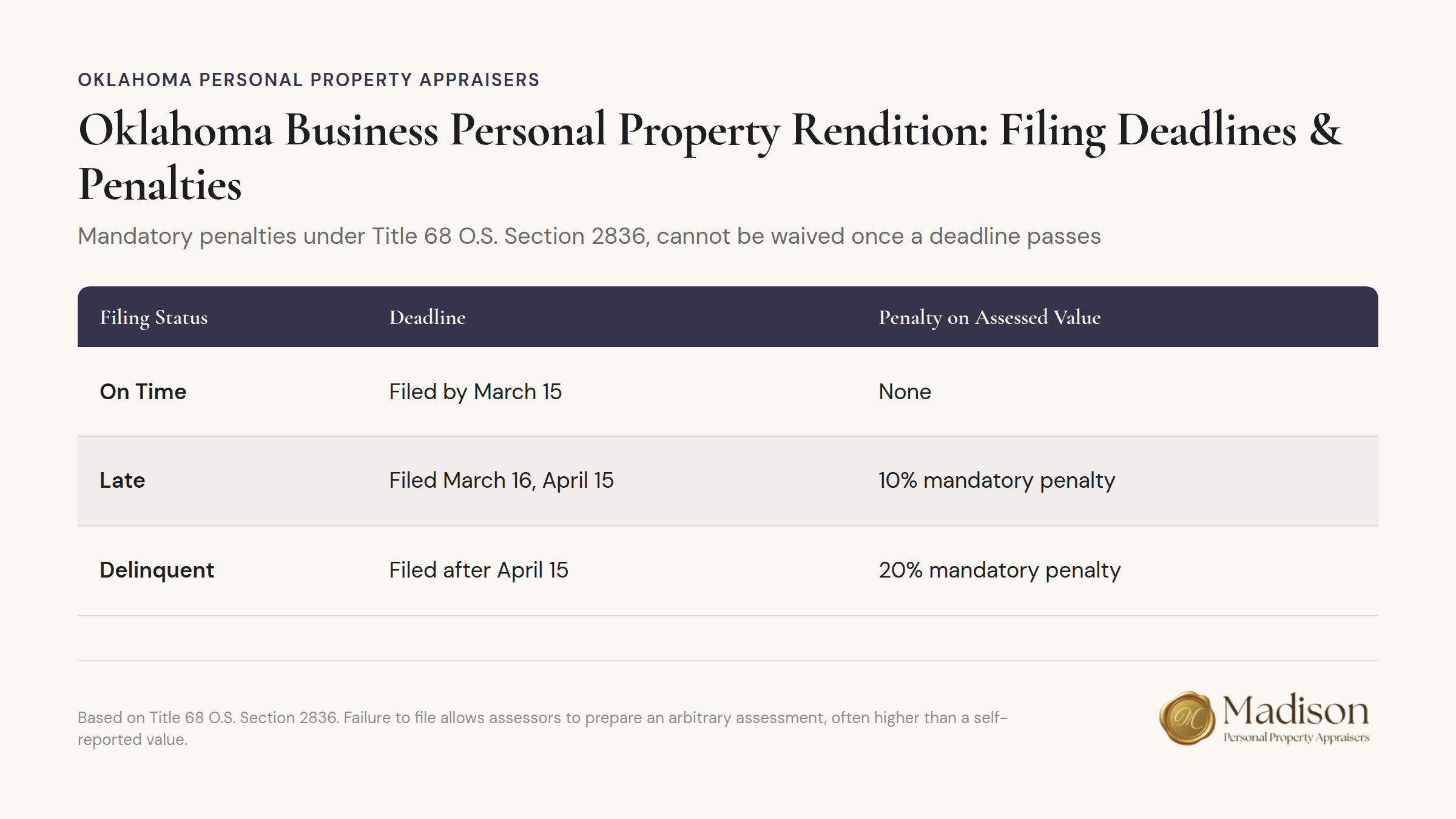
The penalty structure under Title 68 O.S. Section 2836 is mandatory, meaning the assessor's office cannot waive it once a deadline has passed. It steps up in two tiers.
| Filing Status | Deadline | Penalty on Assessed Value |
|---|---|---|
| On time | Filed by March 15 | None |
| Late | Filed March 16 to April 15 | 10% mandatory penalty |
| Delinquent | Filed after April 15 | 20% mandatory penalty |
These penalties are applied to the assessed valuation, not to the raw asset cost, so a higher-value fleet of equipment or a large inventory position means a larger dollar penalty for the same percentage of lateness. If a business fails to file at all, county assessors are authorized to prepare an arbitrary assessment using the best information available, which typically produces a higher value than a business would have reported on its own.
The Postmark Rule for Mailed Renditions
Watch out: If you mail your rendition instead of filing online or in person, the postmark date controls whether you made the deadline, not the date the assessor's office receives and opens it. The Form 901 instructions specify that mailed returns must be postmarked no later than March 15, and postage-metered mail that gets over-stamped by the U.S. Postal Service after March 15 will still trigger the mandatory penalty. If you're cutting it close, drop the envelope at a staffed post office counter rather than a mail slot, and keep the receipt.
How Oklahoma County Assessors Value Your Rendition
The numbers you report on your rendition become the raw material for a mass appraisal calculation, not the final assessed value itself. County assessors take the original cost you report for each asset category, sort it by acquisition year, and apply standardized percent-good depreciation factors published for ad valorem purposes to arrive at an estimated fair cash value.
This is a cost-based, depreciation-table approach, and it's applied uniformly across thousands of businesses in a county at once. That uniformity is efficient for the assessor's office, but it also means the resulting value doesn't necessarily reflect the actual condition, remaining useful life, or true market value of your specific assets. A piece of specialized manufacturing equipment that a standard depreciation table treats the same as generic office equipment can end up over-assessed relative to its real fair cash value.
Key takeaway: The rendition tells the assessor what you own; the depreciation table tells the assessor what it's worth. Those are two different questions, and the second one is where an independent appraisal can matter most.
When an Independent Appraisal Supports Your Rendition or a Protest
A mass appraisal system is built for volume, not precision on any single business's assets. There are several situations where a USPAP-compliant appraisal from a qualified personal property appraiser adds real value alongside, or instead of, the assessor's standardized depreciation calculation:
- Specialized or complex equipment that doesn't fit neatly into a generic depreciation category, such as custom manufacturing lines, medical or lab equipment, or highly specific technology assets
- Mixed-use assets where the line between real property fixtures and taxable personal property is genuinely unclear
- Protesting an assessed value you believe overstates your equipment's or inventory's actual fair cash value, since a protest is far stronger when backed by an independent, defensible valuation rather than an owner's own estimate
- Documenting fair cash value for a business sale, financing, insurance, or estate purpose where the assessor's rendition-based number isn't built for that use
An independent appraisal produces a report distinct from the assessor's mass-appraisal figure, built around the specific condition, age, and market value of your actual equipment and inventory rather than a generic table. If you're weighing whether that level of documentation makes sense for your business, our guide on what a personal property appraiser does walks through the process, and you can request an appraisal directly if you're facing a protest deadline or need documentation before your next rendition is due.
Protecting Your Business Before March 15
The rendition deadline itself is simple to remember: file with your county assessor by March 15, or expect a 10% penalty that climbs to 20% after April 15. The harder part is making sure what you report, and what the assessor's depreciation tables conclude, actually reflects what your business owns and what it's worth. Getting your asset records organized well before the January 1 filing window opens gives you time to catch misclassified assets, question an unexpectedly high prior-year assessment, and decide whether an independent valuation is worth the investment for this year's filing. For more on how personal property valuations are developed and when a formal report is required, browse our personal property appraisal guides.
This article is provided for general informational purposes only and does not constitute legal, tax, or financial advice. Readers should consult a qualified attorney or CPA regarding their specific circumstances.