
Blog
Oklahoma Estate Tax and Personal Property: What Heirs Need to Know Now
Oklahoma repealed its state estate tax in 2010, so heirs owe no state tax on inherited personal property today. This guide explains why a fair market value appraisal of household goods, vehicles, and collections still matters for federal estate tax thresholds, stepped-up basis, and probate inventories.
Oklahoma stopped collecting a state estate tax on deaths occurring on or after January 1, 2010. That means a family settling an estate in Oklahoma today will not see a state tax bill tied to the furniture, vehicles, jewelry, or collections a loved one leaves behind. But the repeal does not make personal property appraisals optional. A federal exemption threshold, a capital gains rule tied to the value on the date of death, and Oklahoma's own probate inventory requirement all still hinge on an accurate fair market value. This guide walks through what changed in 2010, what didn't, and when heirs still need a credentialed appraisal.
Oklahoma's Estate Tax Repeal: What Changed in 2010
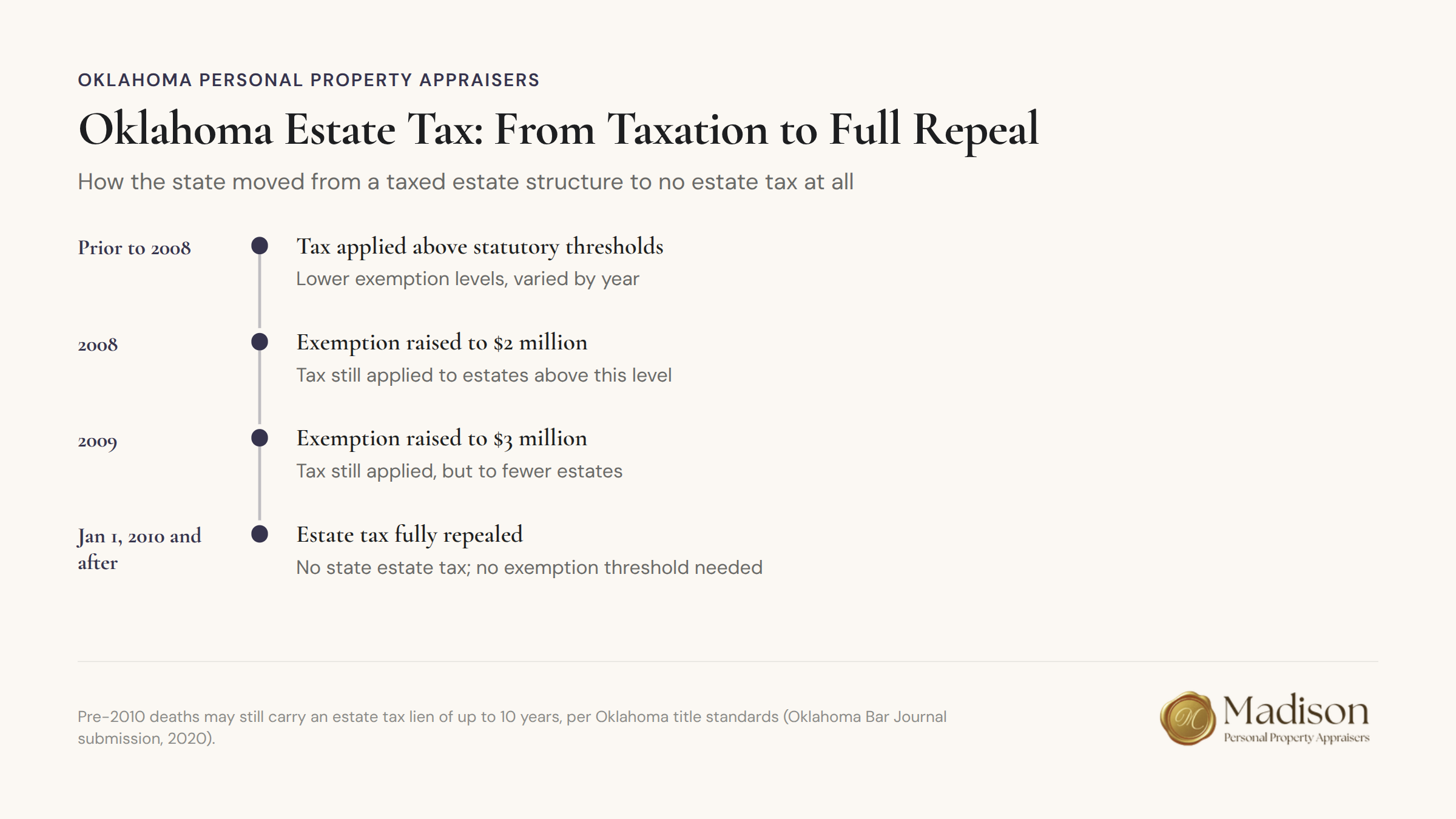
Oklahoma's state estate tax was repealed for deaths occurring on or after January 1, 2010, under a law passed in 2006 that phased the tax out over several years. The Oklahoma Tax Commission's annual reporting confirms the repeal is tied to date of death, not to the size or type of the estate.
Before full repeal, the exemption that shielded estates from Oklahoma's tax had already been climbing: a legislative briefing on the phase-out shows the exemption rose to $2 million in 2008 and $3 million in 2009, before the tax disappeared entirely in 2010. If a family member died in 2008 or 2009, the older thresholds could still be relevant to that estate's history, but for any death from 2010 forward, Oklahoma simply does not impose the tax.
Before Repeal vs. Today: Oklahoma Estate Tax Timeline
The table below lays out how the rule moved from a taxed estate structure to full repeal.
| Period | Oklahoma Estate Tax Status | Exemption Level |
|---|---|---|
| Prior to 2008 | Tax applied to estates above statutory thresholds | Lower exemption, varied by year |
| 2008 | Tax still applied, exemption increased | $2 million |
| 2009 | Tax still applied, exemption increased further | $3 million |
| January 1, 2010 and after | Estate tax fully repealed | Not applicable, no state estate tax |
Watch out: If a loved one died before January 1, 2010, a pre-repeal estate tax lien may still have applied. Oklahoma title standards addressing the state's older estate tax lien rules describe a lien period of up to 10 years from the date of death for those older cases, generally tied to real property. For deaths after that date, no such lien applies.
Does Oklahoma Have an Inheritance Tax Today?
No. Oklahoma currently imposes neither a state estate tax nor a separate inheritance tax on property passing to heirs, regardless of whether the heir is a child, sibling, or more distant relative. This applies to personal property the same way it applies to real estate: household goods, vehicles, bank accounts, securities, and collections all pass to heirs without a state tax bill triggered by the transfer itself.
That simplicity is exactly why some families assume no appraisal is needed at all. It's the wrong conclusion. Two other triggers, one federal and one tied to future taxes, still make a fair market value appraisal worth getting.
Two Reasons Fair Market Value Still Matters
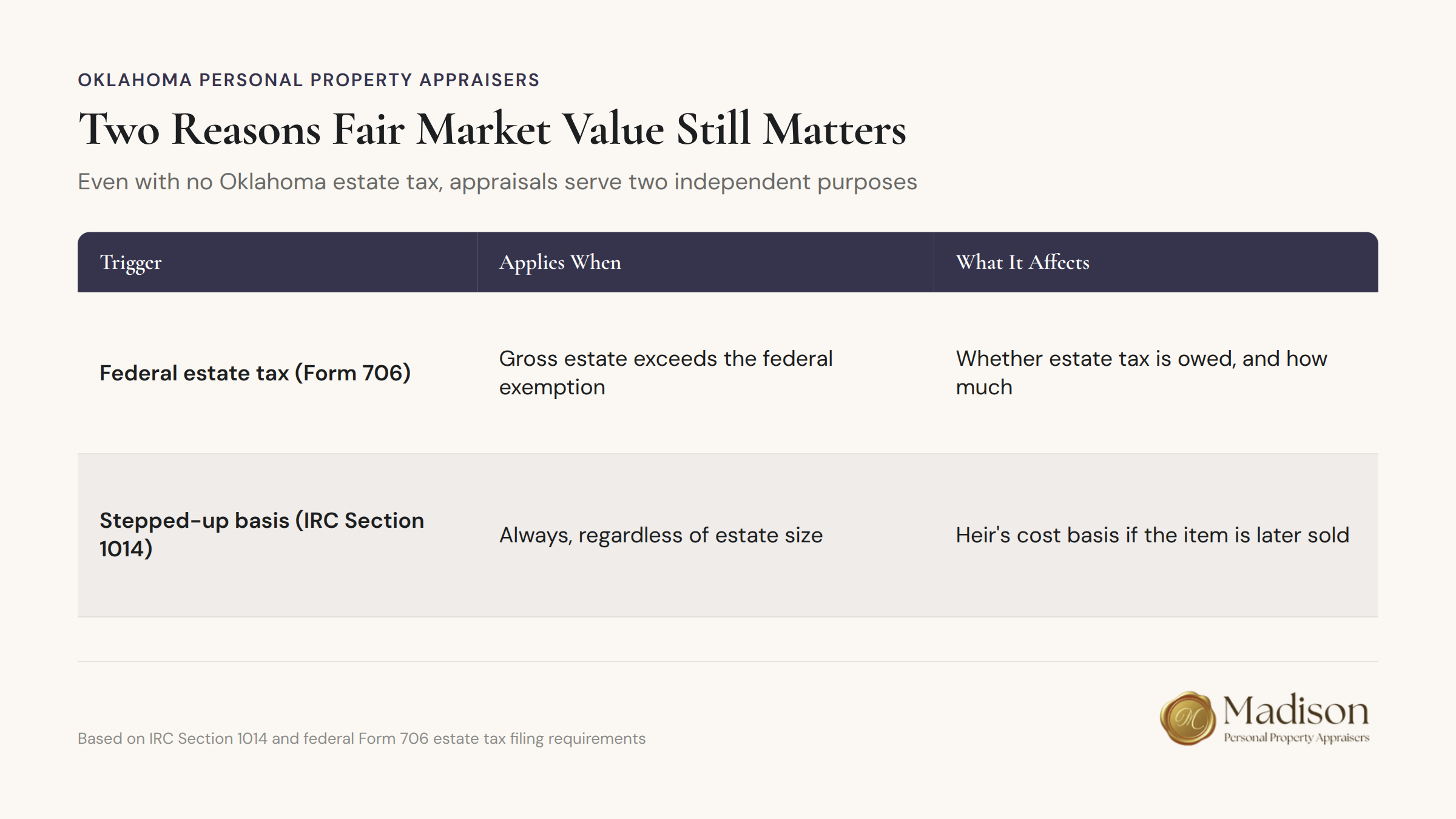
Even with no Oklahoma estate tax, an accurate appraisal of personal property at the date of death still serves two distinct purposes: it supports a federal estate tax filing if the estate is large enough, and it sets the cost basis an heir will use if they later sell an inherited item. These two triggers work independently of each other, and only one requires a large estate.
| Trigger | Applies When | What It Affects |
|---|---|---|
| Federal estate tax (Form 706) | Gross estate exceeds the federal exemption | Whether estate tax is owed, and how much |
| Stepped-up basis (IRC Section 1014) | Always, regardless of estate size | The heir's cost basis if the item is later sold |
The Federal Estate Tax Exemption Still Applies to Large Estates
An estate's personal property can still be swept into a federal estate tax filing even though Oklahoma's state tax is gone. The federal exemption for 2025 is $13.99 million per individual, rising to $15 million in 2026, and estates above that threshold must file IRS Form 706. For most Oklahoma families, the estate will fall well under this exemption and no federal filing is required.
When an estate does approach or exceed the exemption, every category of personal property, including vehicles, artwork, antiques, and collections, needs a fair market value as of the date of death to support the Form 706 filing. Our personal property appraisal services document that value with the kind of defensible, USPAP-compliant methodology a federal filing calls for.
Pro tip: If the estate is close to the exemption threshold, getting a professional appraisal rather than an informal estimate protects the estate from an underreported value that the IRS could later challenge.
Stepped-Up Basis Resets Cost Basis at Death, Regardless of Estate Size
Under the stepped-up basis rule in IRC Section 1014, an heir's cost basis in inherited property generally resets to its fair market value on the date of death. This rule applies no matter how small the estate is; it has nothing to do with whether Oklahoma or the federal government collects an estate tax.
Example: A father bought a vintage truck decades ago for $3,000. At his death, the truck is worth $18,000. His daughter inherits it with a stepped-up basis of $18,000, not the original $3,000. If she sells it a year later for $19,000, she owes capital gains tax on $1,000, not $16,000.
Without a documented fair market value at the date of death, an heir has no defensible number to use when the item is eventually sold, whether that's a vehicle, a coin collection, a piece of jewelry, or a set of antique furniture. The IRS can challenge an unsupported basis claim years after the fact, and by then the estate's records may be hard to reconstruct.
Fair Market Value and the Alternate Valuation Date
Treasury regulations at 26 CFR 20.2031-1 define fair market value for estate purposes as the price a willing buyer would pay a willing seller, with neither under compulsion and both having reasonable knowledge of the relevant facts. That standard is why an informal guess from a family member rarely holds up the same way a credentialed appraisal does.
IRC Section 2032 also allows an estate to elect an alternate valuation date, six months after the date of death, instead of valuing property as of the death itself. This election only applies when it lowers both the gross estate and the resulting estate tax liability, and it is rarely relevant for estates well under the federal exemption. For personal property that changes hands, is sold, or is distributed within those six months, the value used must reflect the date of that disposition rather than the later alternate date.
Oklahoma Probate Still Requires a Personal Property Inventory at Fair Market Value
Oklahoma's repeal of its estate tax did not touch the separate requirement that a personal representative inventory the decedent's property during probate. Oklahoma probate courts still expect household goods, vehicles, and other tangible property listed at fair market value as part of the estate's inventory, independent of whether any tax is owed.
Our guide to how Oklahoma probate courts handle personal property inventory and appraisal walks through that process step by step, including what the court expects from the inventory and when a professional appraisal strengthens it against later disputes among heirs.
Key takeaway: Oklahoma's estate tax repeal removed a state tax bill, not the underlying need to document what personal property was actually worth at the time of death. Probate, federal estate tax exposure, and future capital gains all still depend on that number.
Protect Heirs With a Defensible Appraisal
Oklahoma's 2010 repeal was genuinely good news for families managing an estate: there is no state estate tax and no state inheritance tax standing between an heir and the property they inherit. But a careful fair market value appraisal still earns its keep, whether it's supporting a federal Form 706 filing for a larger estate, locking in a stepped-up basis before an eventual sale, or satisfying a probate court's inventory requirement.
If you're settling an estate in Oklahoma and need household goods, vehicles, or collections valued at fair market value, our team can prepare an appraisal built to hold up for probate, federal tax purposes, or a future sale.
This article is provided for general informational purposes only and does not constitute legal, tax, or financial advice. Readers should consult a qualified attorney or CPA regarding their specific circumstances.