
Blog
Oklahoma City Charitable Donation Appraisal: When IRS Form 8283 and the $5,000 Rule Apply
Donating art, antiques, or household goods to an Oklahoma City museum, university, or thrift-based charity can trigger the IRS $5,000 qualified appraisal requirement under Form 8283, Section B. This guide explains exactly when that threshold applies, what the form requires from the donor, appraiser, and donee, and how the $500 and $20,000 exceptions work.
Every year, Oklahoma City donors clear out attics, closets, and gallery walls and hand pieces of art, antiques, and household goods to the city's museums, universities, churches, and thrift-based charities. Most of these gifts never touch a tax form beyond a receipt from the donee. But once the claimed deduction for an item, or a group of similar items given in the same tax year, tops $5,000, the IRS requires a qualified appraisal and a completed Form 8283, Section B attached to the return.
This guide walks through when that threshold applies, what the form actually demands from each party involved, and the smaller-dollar rules, like the $500 household item exception and the $20,000 art rule, that trip up even careful donors. If you're new to the process generally, our overview of what a personal property appraisal involves is a good starting point before you dig into the tax mechanics below.
When Does an Oklahoma City Charitable Donation Appraisal Trigger the $5,000 Threshold?
A qualified appraisal is required whenever the claimed deduction for a single item, or a group of "similar items" donated in the same tax year, exceeds $5,000. This is spelled out directly in the Form 8283 instructions, and it applies the same way to a donor in Oklahoma City as it does anywhere else in the country. There is no local carve-out and no municipal version of this rule.
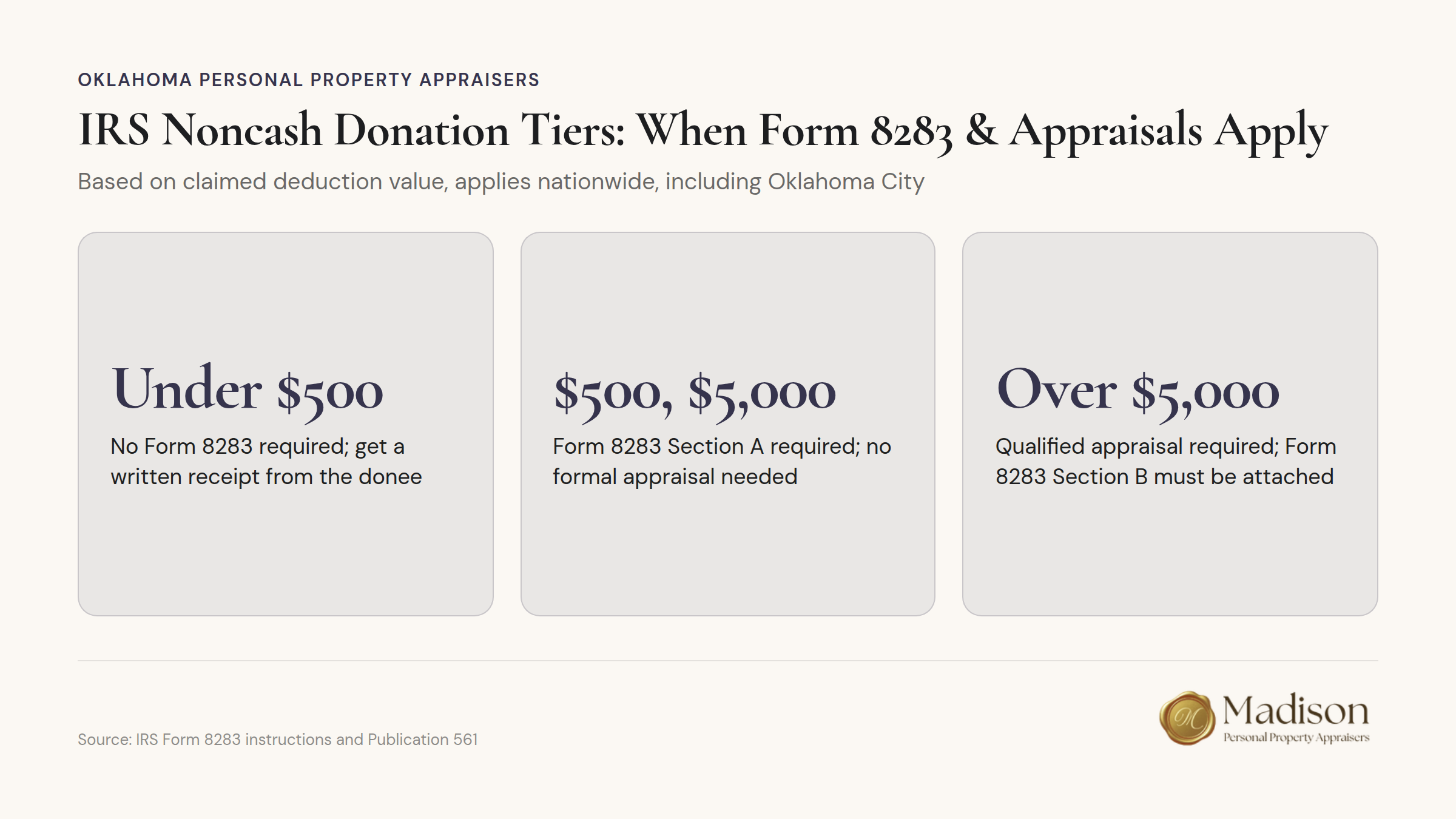
The IRS sorts noncash gifts into three tiers based on the deduction claimed, not on where the gift is made or who receives it:
- Under $500: No Form 8283 is required, though you should still get a written receipt from the donee.
- $500 to $5,000: Form 8283, Section A is required. Most property types do not need a formal appraisal at this level, but you still need a reasonable basis for the value claimed.
- Over $5,000: A qualified appraisal is required, and Form 8283, Section B must be completed and attached to the return.
The part that surprises the most donors is aggregation. If you give multiple items that count as "similar" (think: several pieces of antique furniture, a run of collectible coins, or a group of paintings by the same artist), the IRS tests the combined claimed value against the $5,000 threshold, not each item individually. Publication 561 and the appraiser community have both confirmed that this aggregation applies even when the similar items go to different donees in the same tax year.
Example: Say a donor gives a dining set, a matching sideboard, and a china cabinet, three similar pieces of antique furniture, to an Oklahoma City estate-sale charity. Each piece is worth $2,200 on its own, well under $5,000. But because they're similar items and the aggregate claimed value is $6,600, a qualified appraisal is required for the group, and the appraiser has to sign Form 8283 even though no single piece crossed the line by itself.
This matters most for the kinds of gifts we see regularly from Oklahoma City donors: art and estate collections going to local museums, antiques and archival pieces going to university programs, and larger household-goods donations going to thrift-based charities. Any of those can quietly cross $5,000 in the aggregate even when no individual item looks like a big deal.
What Form 8283 Section B Requires
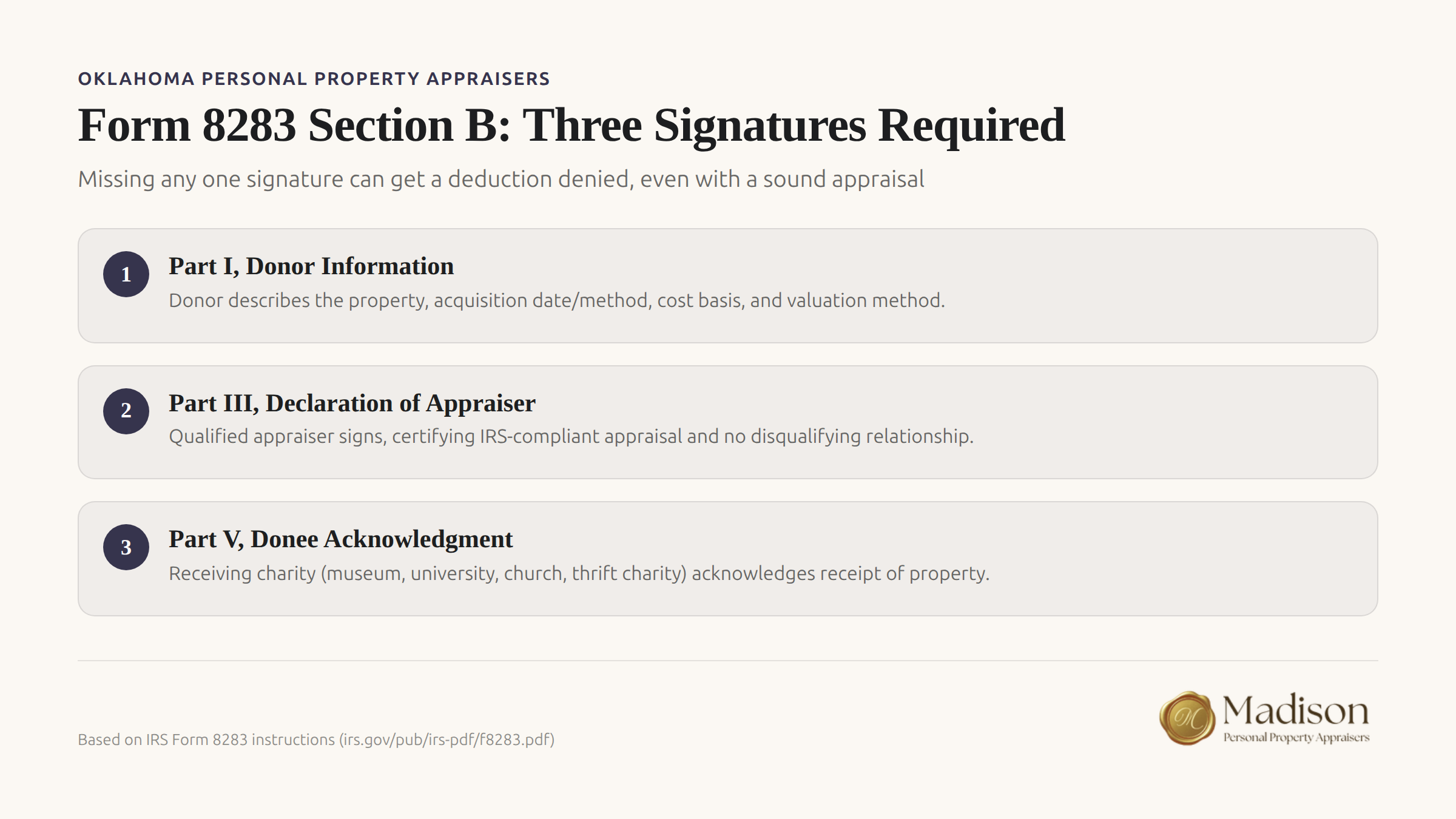
Once a donation triggers Section B, three separate parties have to sign three different parts of the same form. Missing a signature is one of the most common reasons a qualified appraisal gets disallowed on review, according to guidance from the IRS itself.
- Part I, Donor Information. You describe the property, note when and how you acquired it, state your cost basis, and identify the method used to determine fair market value.
- Part III, Declaration of Appraiser. The qualified appraiser signs here, certifying that the appraisal was prepared according to IRS requirements and confirming they have no disqualifying relationship to you or the donee.
- Part V, Donee Acknowledgment. The receiving organization (the museum, university, church, or thrift-based charity) signs to acknowledge it received the property described.
All three signatures need to be in place before the form is filed. If any one of them is missing, the deduction can be denied even if the underlying appraisal itself was sound.
What Makes an Appraiser "Qualified" Under IRS Rules
The IRS does not accept just anyone's opinion of value for a donation over $5,000. A qualified appraiser has verifiable education and experience valuing the specific type of property in question, and holds an appropriate credential or has otherwise met minimum experience standards recognized in the appraisal profession.
Just as important, the appraiser has to be independent. Per the Form 8283 instructions, a qualified appraiser cannot be the donor, cannot be the donee organization, and cannot be a party to the transaction in which the donor acquired the property (so the dealer who sold you the painting last year cannot also be the one who appraises it for the donation).
Our appraisers who prepare charitable donation appraisals for Oklahoma City donors hold credentials with organizations such as the ASA, ISA, AAA, and The Appraisal Foundation, and every report is prepared in accordance with USPAP so it holds up to IRS review. Credentialing standards differ slightly by asset type, real estate appraisers are licensed by the state, while personal property appraisers are typically certified through the professional societies above, so it's worth confirming an appraiser's specific background matches the property you're donating.
Appraisal Fees Cannot Be Based on a Percentage of Value
The IRS prohibits qualified appraisals from being performed for a fee based on a percentage of the appraised value. This rule exists to remove any incentive for an appraiser to inflate a value in order to earn a bigger fee, and an appraisal tied to a percentage-of-value fee arrangement generally does not meet the definition of a qualified appraisal at all, as the IRS guidance on Publication 561 reflects.
Our engagements are always quoted as a fixed fee before we begin work, never billed hourly and never tied to the concluded value. For most Oklahoma City donations of art, antiques, or household goods that need an IRS-qualified appraisal, our advanced qualified-appraisal reports start at $295, with most single-category engagements landing between $395 and $2,200 depending on the number of items, the completeness of the records, and how much research the property requires. Larger collections or unusually complex single pieces can run higher. You can see how scope drives the fee in more detail on our page covering what it costs to get property appraised.
Watch out: If an appraiser offers to work for a cut of the appraised value, or promises to "get you to $5,000" so you qualify for a bigger deduction, that arrangement itself can disqualify the appraisal. The value has to come from independent analysis, not from the fee structure.
The $500 Rule for Household Items and Clothing
Household goods and clothing follow a stricter rule than other property. If you claim a deduction of more than $500 for a single item of clothing or a single household item, and that item is not in good used condition or better, you must attach a qualified appraisal and Form 8283 to your return. This is a separate and lower threshold than the general $5,000 rule, and it exists specifically because clothing and household items are so often overvalued on donation receipts, a pattern the IRS has flagged in its guidance on substantiating noncash contributions.
This comes up often with Oklahoma City donors giving larger household-goods lots to thrift-based charities at the end of a move or an estate cleanout. If most of what you're donating is in good condition, this rule rarely bites. But a single antique item bundled into a household-goods drop-off, one that isn't in "good used condition" by ordinary standards, can trigger the appraisal requirement on its own once the claimed value passes $500.
Donating Art Worth $20,000 or More
Art gets its own, stricter rule on top of the general $5,000 threshold. If you claim a deduction of $20,000 or more for a donated work of art, you must attach the complete qualified appraisal itself to your tax return, not just the Form 8283 summary. The Form 8283 instructions also require a photograph of sufficient size and quality to fully show the piece, and the IRS can request a high-resolution digital image if one wasn't included.
For donations of art appraised at $50,000 or more, you can request a Statement of Value directly from the IRS before you file, giving you a degree of certainty about how the agency will treat the valuation. Oklahoma City donors giving significant pieces to local museums or university art programs are exactly the audience this rule was written for, and it's worth planning the appraisal timeline around it well before the filing deadline, since the appraisal has to be signed and dated within a specific window relative to the contribution date.
Protect Your Deduction Before You Give
The pattern across every one of these rules is the same: the IRS wants a documented, independent, professionally prepared valuation before it will honor a large noncash deduction, and it wants that documentation in place before you file, not assembled afterward under audit pressure. Getting the appraisal date, the Section B signatures, and the appraiser's qualifications right the first time is far easier than trying to fix a disallowed deduction later.
If you're planning a donation of art, antiques, collectibles, or household goods to an Oklahoma City nonprofit and expect the claimed value to land anywhere near $5,000, it's worth having the appraisal in hand before the gift, not after. For more on how appraisers determine value and what qualified reports require, explore our Oklahoma appraisal guides and insights. Our appraisers prepare USPAP-compliant, IRS-qualified reports for donors across Oklahoma City, and you can request an appraisal to get a fixed-fee quote scoped to your specific donation.
This article is provided for general informational purposes only and does not constitute legal, tax, or financial advice. Readers should consult a qualified attorney or CPA regarding their specific circumstances.