
Blog
Home Inventory Documentation for an Oklahoma Insurance Claim: What Adjusters Want to See
Home inventory documentation for an Oklahoma insurance claim comes down to a room-by-room list, matching photos, and proof of value. This guide shows what adjusters want to see, includes a personal property inventory checklist, and explains when to appraise high-value items.
An adjuster can only pay for what you can show existed and what it was worth. After a tornado, hail event, fire, or burglary, the burden of proof sits with you, the policyholder. The strongest Oklahoma claim file is a dated, room-by-room inventory tied to photographs, purchase records, and (for valuables) an appraisal.
Oklahoma City homeowners already know how fast a storm season can turn a living room into a debris field. We covered the claim-stage side in our guide to personal property appraisal for an Oklahoma tornado or hail insurance claim. This post moves the work earlier: what to record before anything happens, what to gather afterward, and what an adjuster wants to see in the file.
What Do Adjusters Want to See in a Home Inventory?
Adjusters want an itemized list that identifies each item, shows it existed, and supports a replacement cost. In practice that means 4 things for every meaningful possession: a description, identifying details such as brand, model, and serial number, a photo, and a record of purchase price and date.
The Oklahoma Insurance Department publishes a home inventory form that follows this same logic. It recommends going room by room, recording serial numbers and purchase information, keeping receipts with the item descriptions, and photographing both wide-angle views of each room and close-ups of valuables. It also recommends photographing the insides of drawers, closets, and cabinets, since those contents are the items people forget and cannot recall later.
The form also stresses where the inventory lives. Keep a copy, preferably digital, somewhere other than the home. A spreadsheet that burned or washed away with the house does nobody any good.
Key takeaway: An inventory does not decide coverage or override a policy limit. It documents the loss so the insurer can apply your policy to real facts.
Personal Property Inventory Checklist by Room
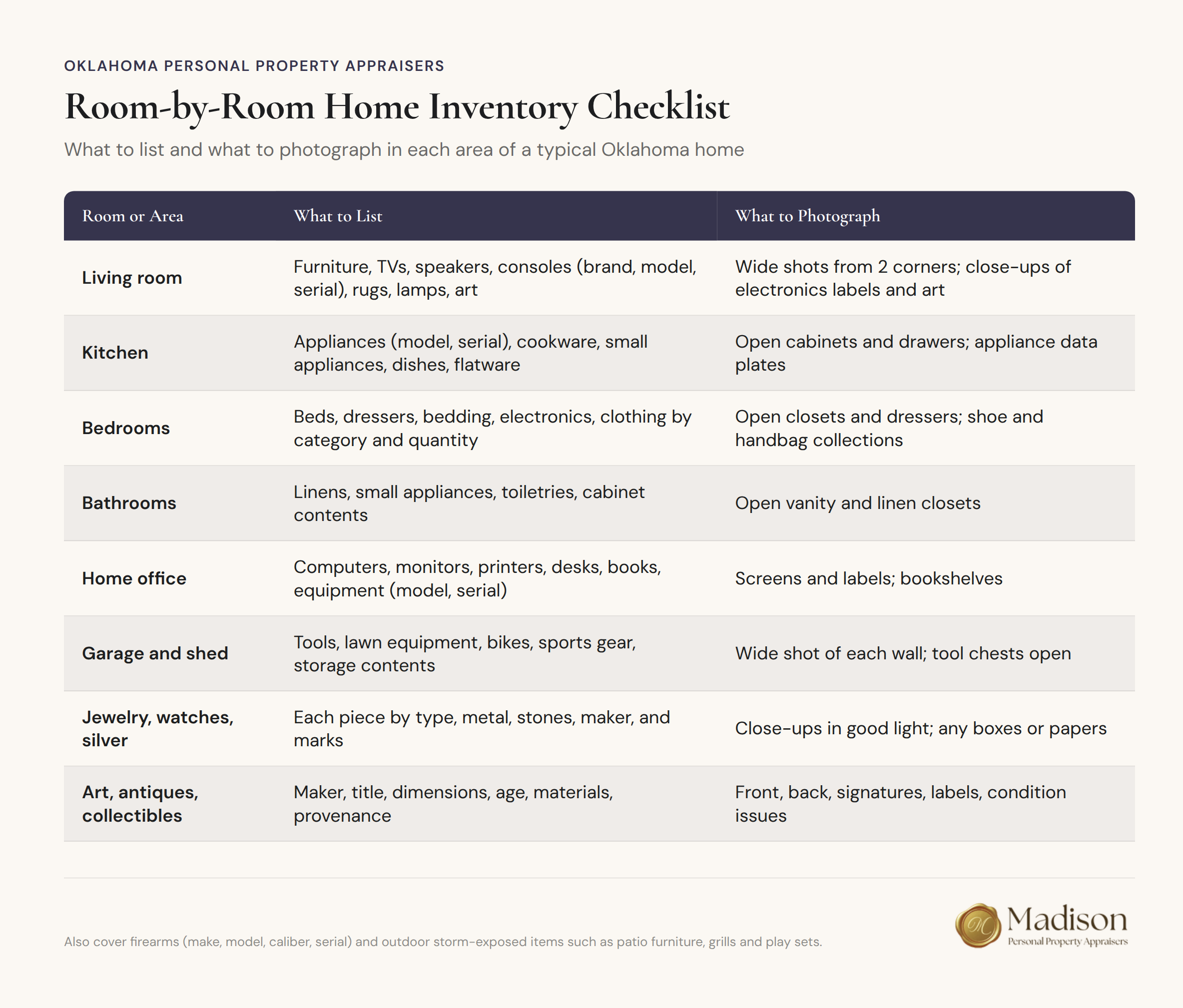
The table below is a working checklist you can copy into a spreadsheet. It shows what to list and what to photograph in each area of a typical Oklahoma home.
| Room or Area | What to List | What to Photograph |
|---|---|---|
| Living room | Furniture, TVs, speakers, game consoles (brand, model, serial number), rugs, lamps, art, decor | Wide shots from 2 corners, then close-ups of electronics labels and art |
| Kitchen | Appliances (model and serial), cookware, small appliances, dishes, flatware | Open cabinets and drawers, appliance data plates |
| Bedrooms | Beds, dressers, nightstands, bedding, electronics, clothing by category and approximate quantity | Open closets and dressers, shoe and handbag collections |
| Bathrooms | Linens, small appliances, toiletries, cabinet contents | Open vanity and linen closets |
| Home office | Computers, monitors, printers, desks, books, equipment (model and serial) | Screens and labels, bookshelves |
| Garage and shed | Tools, lawn equipment, bikes, sports gear, storage contents | Wide shot of each wall, tool chests open |
| Jewelry, watches, silver | Each piece described by type, metal, stones, maker, and any marks | Close-ups in good light, plus any boxes or papers |
| Art, antiques, collectibles | Maker, title, dimensions, age, materials, provenance | Front, back, signatures, labels, and condition issues |
| Firearms | Make, model, caliber, serial number | Full item and serial number plate |
| Outdoor and storm-exposed items | Patio furniture, grills, play sets, anything outside the structure | Items in place, before storm season |
How to Photograph Your Belongings So They Hold Up
Take wide shots first, then close-ups. A wide-angle photo of each room proves what the room contained, and close-ups prove the identity and condition of specific items. Open the drawers, closets, and cabinets and photograph what is inside.
A few habits make the photos far more useful:
- Shoot every room from at least 2 corners: One angle hides what the other shows.
- Capture labels and data plates: Model and serial numbers on the back of a television are what let an adjuster price an equivalent unit.
- Narrate a video walk-through: Describe what you are looking at, such as "55-inch Samsung, purchased 2021, from Best Buy."
- Store copies off-premises: Use cloud storage, or a safe deposit box or a fireproof safe if you keep physical media.
- Update annually: Re-shoot after major purchases, renovations, or inherited items arrive.
Pro tip: Number your photos and key them to the item numbers on your list. When 200 images land in an adjuster's inbox, a numbered system keeps your claim readable.
When Should High-Value Items Be Appraised?
Appraise high-value, collectible, or hard-to-price items before a loss, not after. An adjuster can price a television from a model number, but a signed painting, a silver service, or a gun collection is not something most adjusters can price reliably. A personal property appraisal documents the item's existence, its pre-loss condition, and an itemized replacement value.
There is no single rule for when an appraisal is needed, because it comes from your policy. Some insurers advise appraising items above a set dollar amount, commonly cited as $5,000. Others suggest appraising collections an adjuster may not be able to price readily, and some policies cover only specifically listed items.
That is why these policy features matter:
- Scheduled or listed property: Items named on an endorsement, often with their own agreed values.
- Sublimits: Caps on categories such as jewelry, firearms, silver, or cash, which may be far lower than your overall contents limit.
- Pairs and sets language: How the policy treats a missing piece of a matched set.
- Replacement cost versus actual cash value: Whether depreciation is held back until you replace the item.
Our appraisers prepare personal property reports in accordance with USPAP, the Uniform Standards of Professional Appraisal Practice published by The Appraisal Foundation. Our appraisers hold credentials with leading organizations such as the ISA, ASA, and AAA. Personal property appraisals are delivered online by default, so you send photos and documents and we do the research and write the report; on-site visits are generally reserved for much larger engagements.
The value we report for insurance is replacement value: the cost to replace an item with one of similar kind and quality in the most appropriate marketplace within a reasonable time. That standard-compliant report gives the adjuster something defensible to work from, although the insurer, not the appraiser, decides how the claim is paid.
Example: A homeowner owns a collection of 12 pieces of antique sterling flatware, a signed landscape painting, and a 3-piece jewelry set. Her policy has a $2,500 sublimit on silverware and jewelry theft. A pre-loss appraisal documenting each item's replacement value tells her, before any claim, whether the sublimit leaves her short and whether she should ask her agent about scheduling those pieces.
What Do Appraisals Cost?
Our appraisal fees are quoted as a fixed fee before work begins, and we never bill hourly. For personal property, standard reports start at $195 and IRS-qualified reports start at $295. Most engagements land between $395 and $2,200, and the most complex collections can run from $1,600 to $3,500 or more.
The fee reflects scope: how many items there are, how complex they are, how complete your records are, and the depth of analysis required. It does not change because an item is worth more or less, since value affects the conclusion and not the cost of producing it.
After a Storm, Fire, or Theft: Documenting the Loss
Photograph the damage first, then protect what is left. The National Association of Insurance Commissioners advises policyholders to list all damaged property for the adjuster, photograph or record the damage, and keep receipts for repairs and replacement purchases.
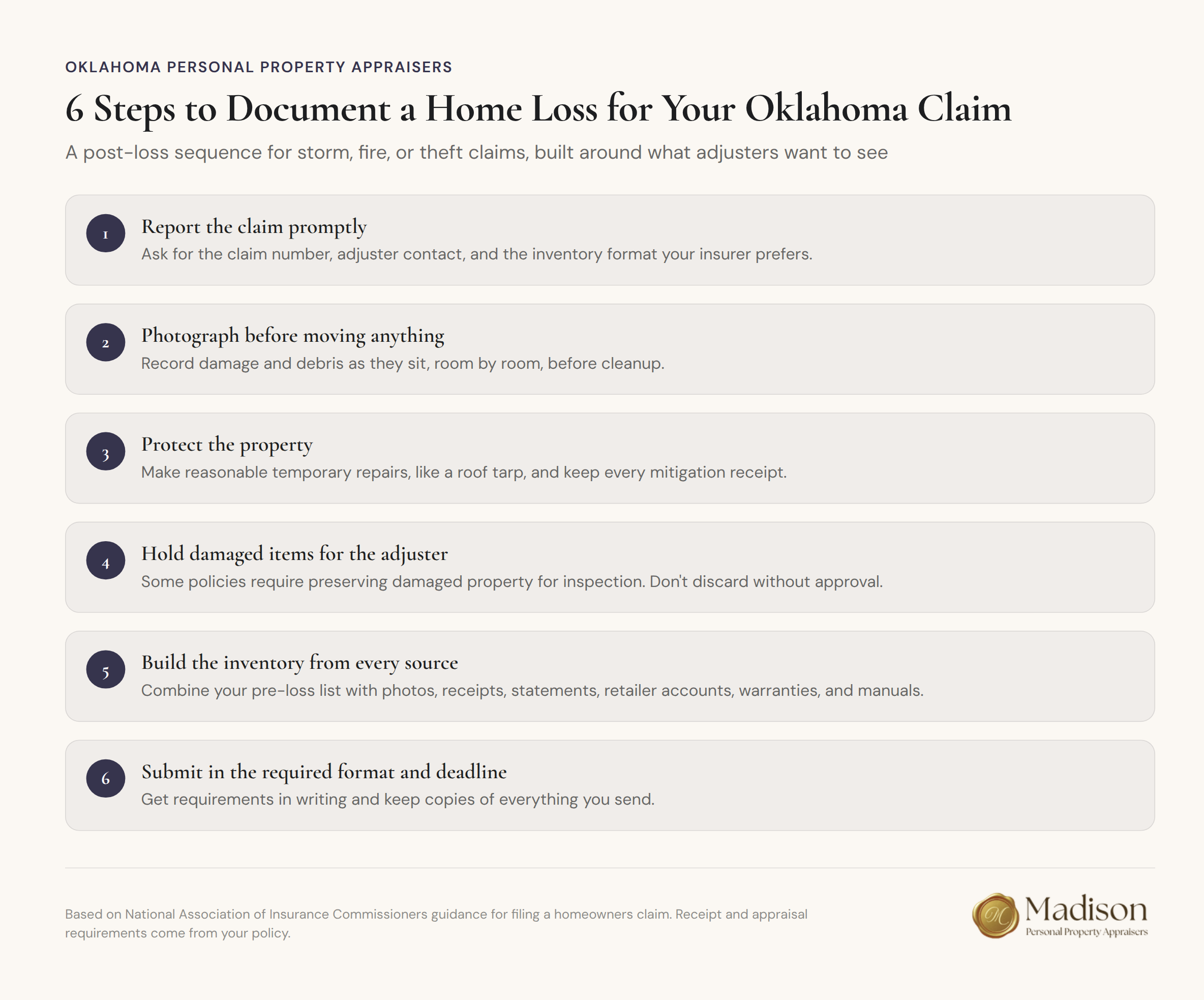
A workable post-loss sequence looks like this:
- Report the Claim Promptly
- Call your insurer and ask for the claim number, adjuster contact, and the inventory format they prefer.
- Photograph Before You Move Anything
- Record damage and debris as they sit, room by room, before cleanup.
- Protect the Property From Further Damage
- Make reasonable temporary repairs, such as a tarp over a hail-damaged roof, and keep every mitigation receipt.
- Hold Damaged Items Until the Adjuster Authorizes Disposal
- Some policies require you to preserve damaged property for inspection, so do not discard it without approval.
- Build the Inventory From Every Source You Have
- Combine your pre-loss list with photos, receipts, bank and credit card statements, retailer accounts, warranties, and manuals.
- Submit in the Format and by the Deadline the Insurer Specifies
- Ask for these in writing, and keep copies of everything you send.
Watch out: Do not assume a receipt threshold you read about elsewhere applies in Oklahoma. The public Oklahoma Insurance Department materials give documentation guidance, but when a receipt, serial number, or appraisal is required usually comes from your policy and the insurer's reasonable investigation.
Proof of Loss: An Inventory Spreadsheet Is Not Enough
A formal sworn proof of loss is a separate requirement from your inventory. Many policies require one within a set period, often 60 days, and the window is commonly emphasized for fire claims. An inventory spreadsheet alone is not a proof of loss.
To stay protected, do the following:
- Read the "Duties After Loss" provision in your policy to find the exact deadline.
- Ask the insurer for its proof of loss form instead of drafting your own.
- Request any extension in writing before the deadline passes, and keep the response.
- Confirm all dates against your policy, since deadlines vary by insurer and by endorsement.
Claim-handling rules in Oklahoma generally require an insurer to acknowledge a claim within a set number of business days and to accept, deny, or explain its position within a set period after a properly executed proof of loss. The figures commonly cited are 30 business days to acknowledge and 45 business days to respond after proof of loss, but confirm the current requirements with your policy and the Oklahoma Insurance Department. A late or incomplete proof of loss can slow all of that down.
Build the Inventory Now, While the Sky Is Clear
The best time to document your home is before the next storm warning. Start with the garage and the closets, where forgotten items pile up. Then photograph each room, log serial numbers, scan receipts into a folder, and send your jewelry, art, antiques, and collections for appraisal so their values are on record.
We prepare personal property appraisals for Oklahoma homeowners in accordance with USPAP, delivered online and quoted as a fixed fee. When you are ready to put your valuables on record, you can request an appraisal and tell us what you need documented.
This article is provided for general informational purposes only and does not constitute legal, tax, insurance, or financial advice. Policy terms, deadlines, and claim-handling rules vary. Readers should review their own policy and consult their insurer, a licensed insurance professional, or an attorney regarding their specific circumstances.